A main sewer line problem is one of the few home failures that can ruin your week and your floors at the same time. But it almost never happens out of nowhere. The main line gives you a series of warnings, escalating over weeks or months, and most people don’t connect them until they’re standing in the basement looking at something they really don’t want to be looking at.
The other thing worth knowing up front: a sewer line problem can be a $200 snaking or a $10,000 excavation, and the only way to know which is to look inside the pipe with a camera before anyone digs. Here are the five signs, and how to keep yourself out of the expensive ditch.
Sign 1: More than one drain is slow or backing up at once
A single slow drain is a local clog — hair in the bathroom sink, grease in the kitchen line. Annoying, but contained.
When multiple fixtures back up at the same time — the kitchen sink gurgles when the washing machine drains, the basement floor drain bubbles up when you flush, the toilet backs up when you run the shower — that’s not a local clog. That’s the main line that everything drains into. The lower the fixture, the earlier it shows: your basement floor drain and lowest toilet are the canaries, because they’re at the bottom of the system and they back up first.
If two or more drains misbehave together, stop thinking “clogged sink” and start thinking “main line.”
Sign 2: Gurgling toilets and drains when you use water elsewhere
Listen to your house. When you run the washing machine, does the toilet gurgle? When you drain the tub, does the toilet bubble or the water level move on its own?
That gurgling is air. When the main line is partially blocked, water draining from one fixture can’t move freely, so it pulls air through the nearest trap — usually the toilet — and you hear it gurgle and see the water dance. A toilet that talks back when you run water somewhere else is a classic early main-line sign, well before anything actually backs up.
Sign 3: A sewage smell in the yard or basement
A working drain system is sealed and vented to the roof — you should never smell sewer gas inside or around the house. If you do, something is leaking where it shouldn’t.
- A rotten-egg / sewage smell in the basement can be a dried-out floor-drain trap (easy — just pour water in it) or a cracked drain line.
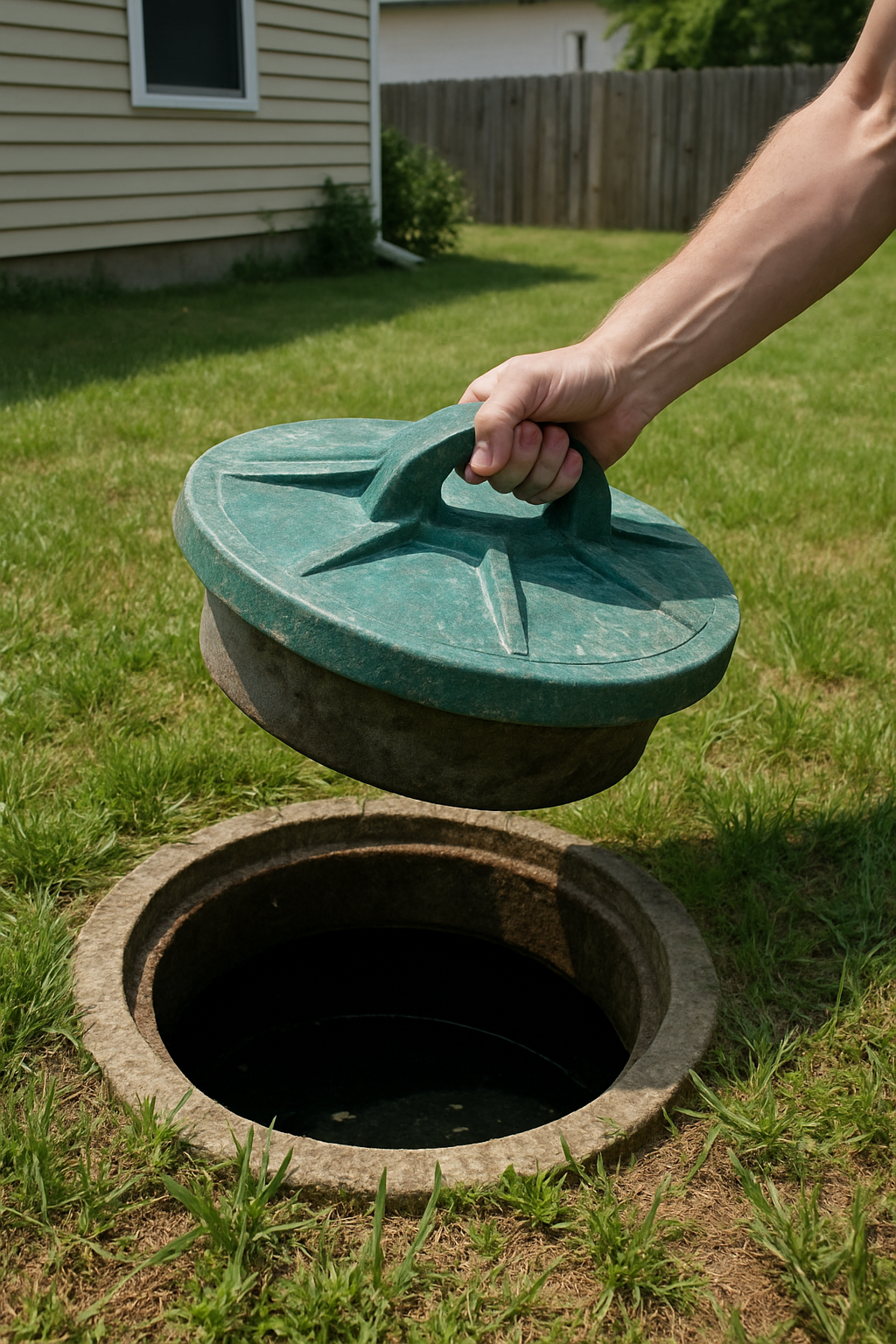
- A sewage smell outdoors, especially near the line’s path to the street or septic tank, often means the buried line is cracked or leaking underground.
Smell is a real signal. Don’t air-freshener your way past it.
Sign 4: A soggy or unusually green patch in the yard
Walk the path of your sewer line — roughly a straight shot from the house toward the street (city sewer) or toward the tank and drain field (septic). Look for a strip or patch of lawn that’s:
- Soggy or spongy when the rest of the yard is dry,
- Greener and growing faster than everything around it, or
- Sunken or depressed along the line.
A leaking sewer line is, unfortunately, excellent fertilizer. A suspiciously lush green stripe across an otherwise ordinary lawn is the line telling you it’s leaking underground. (On septic systems, a wet, smelly area near the drain field points to a failing field — a related but different problem.)
Sign 5: Backups that come right back after snaking
This is the one that separates a clog from a structural problem.
If a plumber snakes the line, it clears, and then it backs up again within weeks or months — over and over — you don’t have a clog. You have one of two things:
- Root intrusion: tree roots have found a joint or crack in the pipe and grown into it. Snaking cuts them temporarily; they grow back. Common in older clay or cast-iron lines.
- A bellied or collapsed pipe: a section of line has sagged or broken, so waste pools and re-clogs there no matter how often you snake it.
Repeated backups after snaking is the signal to stop snaking and start looking.
The move that saves the money: scope it before you dig
Here’s the part that protects your wallet. Before you let anyone excavate your yard or quote you a pipe replacement, get a sewer camera scope. A plumber feeds a camera down the line and you watch the screen with them. For a couple hundred dollars you find out exactly:
- Where the problem is (so any dig is targeted, not exploratory),
- What it is (clog, roots, belly, crack, or collapse),
- Whether it’s even your responsibility — in most places the homeowner owns the lateral from the house to the city main, but the exact line and any easements matter, and the scope shows you the boundary.
A $200 scope routinely turns a $10,000 “we’ll have to dig and see” into a $1,500 targeted spot repair — or reveals it’s a simple root cut, not a replacement at all. Never authorize digging based on a guess.
How to apply this
- One slow drain = local. Multiple at once = main line. Don’t keep treating it as a sink clog.
- Listen for gurgling when you run water elsewhere — that’s the early warning.
- Walk the line in the yard for soggy or extra-green patches.
- If it comes back after snaking, scope it. Roots or a belly won’t clear with a cable.
- Camera before excavator. Always.
Want a read before you authorize a dig?
If you’ve got slow drains, gurgling, a yard patch, or a backup that keeps returning, send me three photos for a $19.99 diagnostic report — the affected drains or fixtures, any wet/green spot in the yard, and (if you have it) a still from a plumber’s camera scope.
I’ll tell you whether you’re looking at a snaking, a root problem, or a real dig — and exactly what to insist on before you let anyone put a shovel in the ground.
You can also see drainage and plumbing work I’ve done for a sense of what’s actually under there.
The most expensive sewer mistake is digging on a guess. The cheapest insurance is the camera that tells you where to dig — or that you don’t need to.