When something electrical isn’t working in the house, calling an electrician is the safe default — but $200-$400 minimum just to walk in the door. Many household electrical problems have causes you can identify yourself in 15 minutes, and some you can fix without a license.
The rule: stay safe by doing diagnosis only at the panel and at outlets, with the breaker off. Don’t open junction boxes inside walls. Don’t touch anything you can’t verify is dead. Within those rules, you can identify the source of most problems before you spend money on a service call.
Here’s the safe diagnostic sequence.
Tools You Need
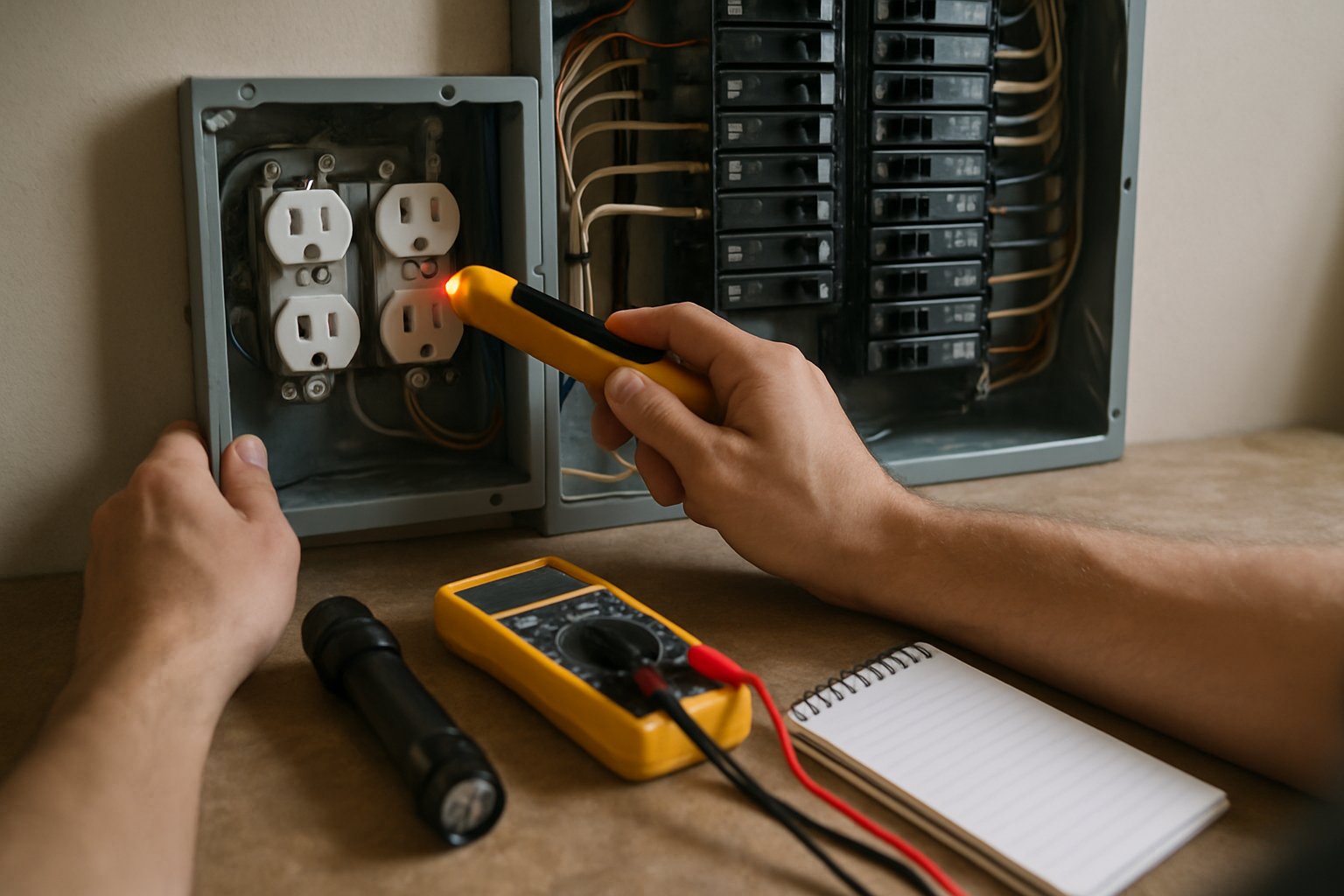
- Non-contact voltage tester ($10-$15) — the pen-shaped tool. Confirms if a wire is hot.
- Outlet tester ($10) — three-LED tester that plugs into an outlet, showing wiring problems.
- Flashlight or headlamp
- Phone with camera — document everything
For deeper work:
- Multimeter ($25-$50) — measures voltage and continuity. Useful but not essential for first-pass diagnosis.
- Circuit tracer / breaker finder ($30-$60) — identifies which breaker controls which outlet. Saves time when panel labels are wrong (which is most houses).
Problem Type 1: Single Outlet Stopped Working
Most common household electrical complaint. Diagnose in 5 minutes.
Step 1: Test the outlet with a non-contact voltage tester.
- Hold the tester near each slot of the outlet.
- If the tester is silent: no power reaching the outlet.
- If the tester beeps: power is there but something downstream of the outlet is broken (less common).
Step 2: Check the GFCI. Many outlets are protected by a GFCI somewhere “upstream” — often in the bathroom, kitchen, garage, or outside. If one of those GFCIs has tripped, it kills power to all the outlets downstream of it.
- Walk around the house pressing the “TEST” then “RESET” button on every GFCI you find.
- After reset, check your dead outlet again. Often this is the fix.
Step 3: Check the breaker.
- Open the panel. Look for a breaker that’s in the middle (between fully on and fully off — that’s the “tripped” position) OR fully off.
- Flip it fully off, then back on. Does the outlet work now?
Step 4: If still dead: the outlet itself or the wiring to it has failed. Replacement is DIY (separate post on that). Tracing a break in the wire is electrician territory.
Problem Type 2: Breaker Trips Repeatedly
A breaker that trips when you turn on a specific appliance, or trips intermittently for no reason, is telling you something.
If it trips when a specific appliance starts:
- The appliance is drawing more current than the circuit is rated for.
- Solution: move that appliance to a different circuit. If you can’t, the circuit may need an upgrade (electrician).
If it trips with multiple things on at once:
- The combined load exceeds the breaker rating.
- Solution: spread the loads — don’t run the microwave + toaster + coffee maker all at once on a 15-amp circuit.
If it trips for no apparent reason:
- Could be a short somewhere in the wiring.
- Could be the breaker itself failing (rare but possible).
- Could be an arc-fault (AFCI) breaker tripping due to legitimate arc detection.
- Now you’re at the diagnostic limit of DIY. Call an electrician.
Problem Type 3: Lights Flickering
One light flickers:
- Bulb: try a new bulb first. Most common cause.
- Fixture connection loose: turn off breaker, check wire connections at the fixture.
- Switch failing: replace the switch.
Many lights flicker (whole room or whole house):
- Loose neutral connection at the panel: this is the most concerning case. Causes voltage instability that can damage electronics throughout the house. Call an electrician within the day.
- Voltage from utility: contact the utility company. Sometimes their pole-side connection is the issue.
Lights flicker when AC or large appliance starts:
- Normal momentary dip during motor startup. Slight flicker is fine.
- Significant dim or flicker: undersized service to the house. Electrician.
Problem Type 4: Outlet Is Warm or Discolored
Treat as urgent. A warm outlet is heating from internal arcing — a fire risk.
- Stop using the outlet immediately.
- Turn off the breaker that feeds it.
- Replace the outlet (DIY) or call an electrician.
- While you’re at it, check the breaker itself — sometimes the issue is at both ends. If the breaker terminal is also warm, the breaker may need replacement too.
Problem Type 5: Buzzing, Sparking, or Burning Smell
Buzzing from a switch:
- Could be a worn switch (replace it).
- Could be arcing wires inside the switch box (electrician).
- Could be a dimmer overloaded by LED bulbs (use LED-rated dimmer).
Sparking from an outlet when plugging in:
- Small momentary spark on plug-in is normal.
- Visible flames or sustained sparks: stop using, turn off breaker, replace.
Burning smell:
- ALWAYS investigate. Walk to every outlet, switch, and panel and smell directly.
- The smell tells you where the problem is.
- Hot or discolored outlets / switches: replace immediately.
- Smell from the panel: kill the main breaker and call an electrician.
Problem Type 6: Whole House Loses Power
Step 1: Look outside. Are your neighbors’ lights on?
- All neighbors dark = utility outage. Wait or report.
- Just you = something at your panel or in your service.
Step 2: Check the main breaker.
- The big breaker at the top of the panel. If tripped, flip off then back on.
- Many overloads trip the main when several smaller breakers trip at once.
Step 3: If the main keeps tripping:
- A serious problem somewhere in the house. Electrician territory.
Common Mistakes
- Working on energized circuits. Always kill the breaker AND verify with a voltage tester before touching wires.
- Resetting a tripped breaker without finding the cause. A breaker that trips repeatedly is doing its job — telling you something is wrong. Find the cause.
- Ignoring warm or discolored outlets. Fire risk increases with each day.
- Trusting panel labels. Most are wrong. Use a circuit tracer to verify which breaker controls which outlet.
- Opening junction boxes inside walls without expertise. The boxes you can access are mostly safe. The buried ones often have older, more dangerous wiring.
When to Call an Electrician
- Anything in the panel beyond resetting a breaker
- Any wiring inside a wall
- Any AC service or main service-related issue
- Aluminum or knob-and-tube wiring
- Anything that smells, sparks, or arcs visibly
- A breaker that trips repeatedly and you can’t identify why
- Adding any new circuits or expanding service
The Bottom Line
Most household electrical problems are diagnosable from the outlet or panel level — without opening walls or doing risky work. The rule is simple: kill the breaker, verify dead, replace simple parts (outlets, switches, fixtures), call a pro for anything inside a wall or panel.
For the full diagnostic flowchart, every common cause, and the safe-DIY-vs-call-pro decision tree, see Diagnose an Electrical Problem Safely.
For complex or persistent electrical issues, or before a renovation that affects wiring, send your photos for a $19.99 diagnostic report.