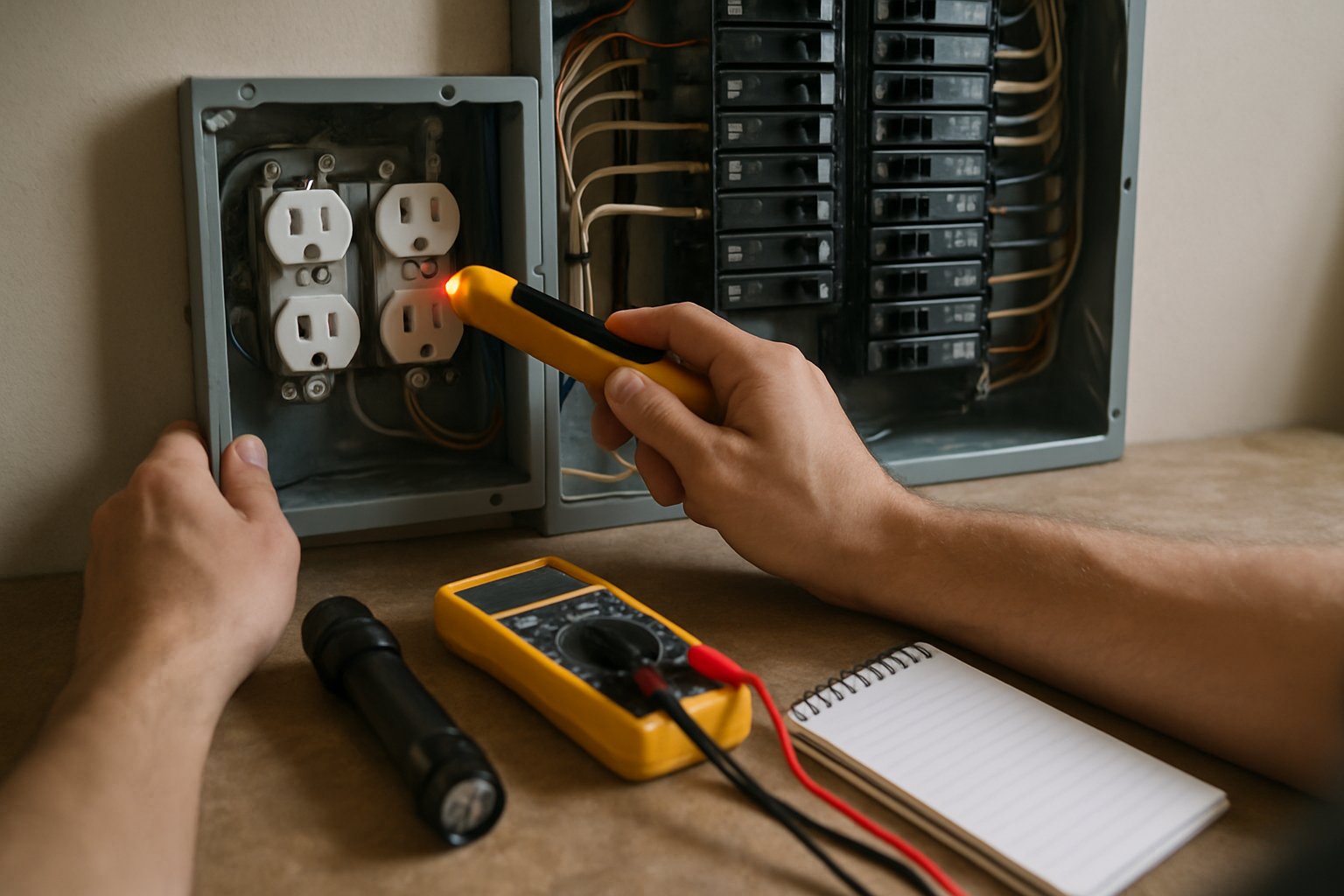
Your breaker trips and someone tells you that you need a new electrical panel. Maybe you do. Maybe you need a twenty-dollar breaker. Here’s how to tell the difference — because they’re not the same call at all, and the wrong answer in either direction costs you real money.
I’ve replaced panels and I’ve replaced individual breakers, and the distinction matters. A panel replacement with an electrician runs $1,500 to $4,000 depending on your service size and location. A new breaker is $15 and an hour. Here’s what drives the real decision.
First: the breaker is almost never the problem
A breaker that trips is doing its job. It trips because the circuit is overloaded — too many things drawing current on the same 15 or 20 amp circuit — or because a device has developed a short. The fix is almost always: identify what’s drawing too much current, redistribute the load, or replace the failing device. The breaker itself is fine.
A breaker that trips repeatedly on the same circuit, won’t reset, or resets but trips immediately is a different issue — but it’s still usually a worn breaker on an overloaded circuit, not a panel failure. Replace the breaker. If the new breaker trips on the same circuit, the circuit has a problem (a short, damaged wiring, or an undersized wire for the load).
So when is the panel itself the problem?
Sign 1: Federal Pacific or Zinsco — replace regardless of symptoms
Open your panel and look for the brand name Federal Pacific Electric (sometimes Stab-Lok on the breakers themselves), or Zinsco or Sylvania. These manufacturers made panels that were recalled or found to have a serious defect: breakers that don’t trip when they should under overload conditions.
If the breaker doesn’t trip, the wiring overheats. If the wiring overheats, you have a fire in the wall before you have a tripped breaker. This is a known fire hazard documented in case law and building investigations across the country.
If you have a Federal Pacific or Zinsco panel, get a licensed electrician to replace it. Not because something is actively tripping or failing — because the design itself is a hazard that no amount of breaker replacements will fix.
Sign 2: Double-tapped breakers
Look at the breaker terminals inside your panel. Each breaker terminal should have exactly one wire connected to it. If you see two wires going into the same breaker terminal — called double-tapping — that is a code violation in most panels (some panels are specifically listed for two wires; most are not).
Double-tapping happens when the panel ran out of spaces and a subsequent electrician added a circuit without adding capacity. It’s a sign the panel is full. Double-tapping by itself doesn’t always mean the panel needs replacing — it might be solved by a sub-panel or by a tandem breaker where one is allowed — but it does mean you’re out of capacity and need an electrician to assess it.
Sign 3: 100-amp service in a modern house
Look at your main breaker. If it’s rated for 100 amps and you’re running a modern house — multiple HVAC systems, an electric dryer, an electric range, an EV charger, high-draw appliances — 100 amps is very likely undersized.
The signs: lights dim noticeably when the air conditioner kicks on. Breakers trip not because they’re faulty but because the total demand on the panel is approaching the service limit. This isn’t a breaker problem and it isn’t a panel problem per se — it’s a service upgrade, which means a new meter base, a new panel, and coordination with the utility to upgrade the service entrance wiring.
A 200-amp service is standard in new construction. Going from 100 to 200 runs $1,500 to $3,500 depending on local utility fees and whether the panel location is easy to access.
Sign 4: Burn marks, scorching, or buzzing
Open the panel door and look. Any burn marks or heat discoloration — dark brownish-black scorching on the bus bar, around a breaker terminal, or on the insulation of a wire — is an electrician-today situation. Not a call-around-for-quotes situation. A hot spot in a panel can cause a fire inside the wall before you ever see a tripped breaker or smell anything outside the panel cabinet.
Same with a persistent buzzing or humming sound from the panel itself (not from a specific appliance on a circuit). That can indicate arcing inside the panel, which is a fire precursor.
Sign 5: Age and mechanical wear
Panels from the 1950s through the 1970s are approaching or past end of life. The breakers themselves are mechanical devices — they trip by a spring mechanism — and that mechanism wears out. A worn breaker may not trip reliably at its rated amperage.
An electrician can test breakers with a breaker tester. If a significant portion of the breakers in an older panel fail the test, you’re looking at replacing most of the breakers or the whole panel. At that point replacing the panel usually makes more sense than buying a collection of old-format replacement breakers that may be hard to source.
The summary
A breaker that trips: check the load on that circuit, replace the breaker if it won’t reset.
A panel that needs replacing:
- Federal Pacific or Zinsco brand — replace now
- Double-tapped and out of capacity — assess with an electrician
- 100-amp service with modern load demands — consider a service upgrade
- Burn marks, scorching, or buzzing — call an electrician today
- Original to a house from the 50s–70s — test the breakers
If you’ve got a quote in front of you and you’re not sure whether you need a new panel or just a new breaker, send me a photo of the open panel with the door swung wide. I’ll tell you what I’d do. hammondreengineered.com/report — $19.99.