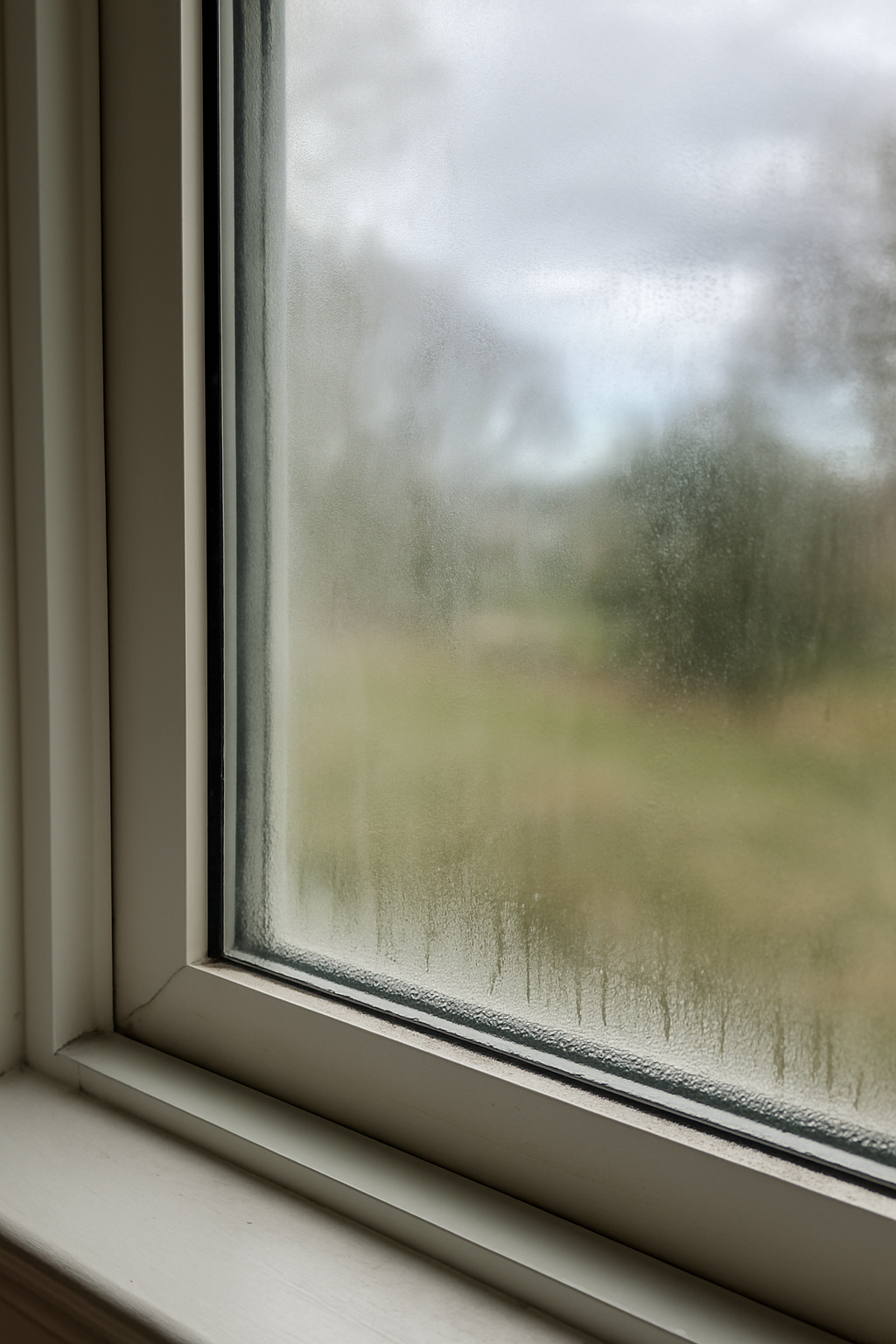
You clean the window, inside and out, and the haze is still there — sitting between the panes where you can’t reach it. That’s not dirt. It’s condensation trapped inside a sealed unit whose seal has failed, and no amount of Windex touches it. The panic move is pricing a full set of replacement windows. Most of the time, that’s not actually what you need.
Here’s what’s really going on, and the fix that costs a fraction of new windows.
What’s actually failing
A double-pane (or triple-pane) window is really two pieces of glass sealed together at the edges with a spacer, and often filled with argon or another inert gas for insulation. That edge seal is the weak point. Over years of heat, cold, and UV exposure, it degrades and eventually lets outside air — and moisture — in between the panes. Once humid air is trapped in there, it condenses every time there’s a temperature difference, and you get the fog. The seal doesn’t self-heal, and cleaning does nothing because you can’t reach the inside surface.
Don’t fall for the reseal kits
You’ll find drill-and-inject kits online that claim to fix foggy glass by drilling a small hole, extracting the moisture, and injecting a drying solution or sealant. At best these are a temporary cosmetic fix — the underlying seal is still broken, the unit will fog again, and you’ve now also put a hole in your glass. This isn’t a real repair, and I wouldn’t spend money on one expecting it to last.
The actual fix: replace the glass, not the window
If the window frame and hardware are in good shape — it opens, closes, locks, and the wood or vinyl around it isn’t rotted or cracked — the real fix is replacing just the insulated glass unit (IGU) within the existing sash. A glass shop measures your opening, builds a new sealed unit to match, and a window installer swaps it in. This typically runs a few hundred dollars per window, well under the cost of a full window replacement, and it looks and performs like new because it is new — just the glass, not the whole assembly.
When you actually need a new window
Replace the entire window, frame and all, when:
- The frame is rotted, cracked, or the wood has gone soft — a new glass unit in a failing frame doesn’t fix the frame.
- The hardware doesn’t work — it won’t stay open, the lock is broken, or it’s painted shut beyond saving.
- It’s a single-pane window with no insulated unit at all — there’s no glass unit to swap, the whole assembly needs to be modern.
- You want a real performance or style upgrade — different frame material, better energy rating, or a different look, independent of the fog issue.
One or two windows fogging, or most of them?
If it’s isolated to one or two windows, that’s a normal individual seal failure — just fix those. If most or all of your windows are fogging around the same age, it usually means they’re all from the same batch or era and the seals are wearing out together — still just a glass-unit swap per window, not necessarily new frames, unless the frames themselves show the wear signs above.
The decision, simply
Replace the glass unit if the frame and hardware are sound — this fixes the fog for a fraction of new-window cost. Replace the whole window if the frame is rotted, the hardware has failed, or it’s a single-pane unit with no insulated glass to begin with.
DIY or not
Measuring for and installing a replacement insulated glass unit is a job for a glass shop — the unit has to be built to precise dimensions and installed without breaking the seal again. Full window replacement is more accessible to a capable DIYer for standard sizes, but still benefits from a second set of hands and careful attention to flashing and sealing against water intrusion.
Not sure which one you’re looking at?
Send me a photo of the foggy window and a close-up of the frame and hardware. I’ll tell you whether you’re looking at a simple glass swap or the whole window needs to go — a written diagnostic with the specific fix and honest cost, $19.99, back to you in minutes.