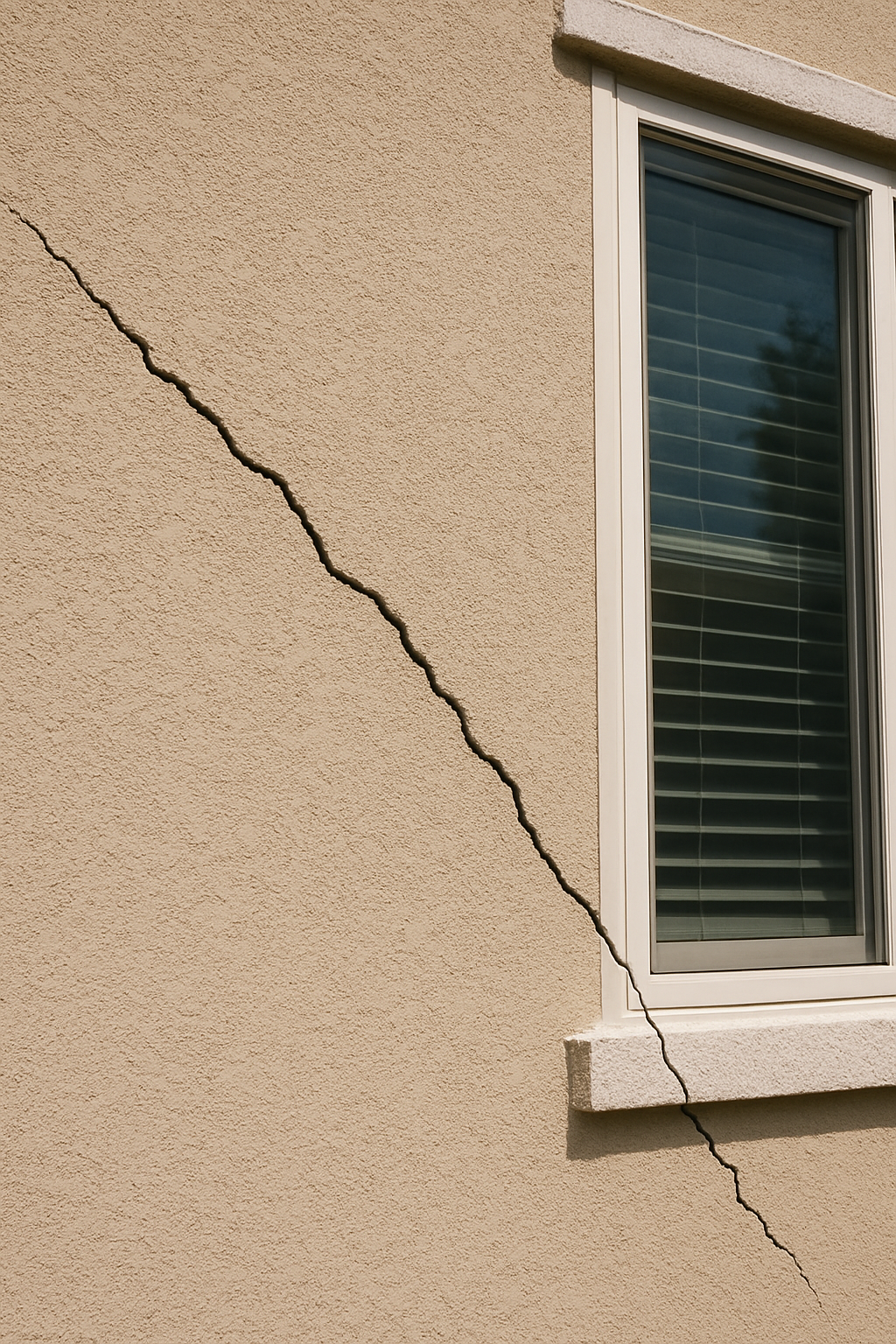
A crack running through the stucco — maybe near a window corner, maybe just out in the middle of a wall — looks like the whole exterior is starting to fail. Before you price a full re-stucco job, know this: stucco cracks constantly as a house settles and temperatures swing, and most of what you’re looking at is cosmetic. But there’s a real difference between that and a spot where water has already worked its way behind the stucco, and knowing which one you’re looking at changes whether this is a weekend patch or a much bigger job.
Here’s how to tell which situation you’re in.
Check the crack width first
Stucco is a rigid material applied over a house frame that naturally moves — with temperature, humidity, and minor settling. Hairline cracks, thinner than a credit card is thick, running in a fairly straight or slightly branching pattern, are normal and expected, especially around windows, doors, and corners where stress concentrates. These don’t mean the stucco is failing. Clean the crack, fill it with a flexible masonry caulk or stucco patch compound, and it’s done. Cost: under $20 in materials. Time: under an hour.
The push test: is water already behind it?
Once you’ve confirmed the crack itself is thin and stable, do this: press firmly on the stucco within a foot or two of the crack, especially lower on the wall or below windows. If it feels solid, you’re looking at a cosmetic crack. If it feels soft, spongy, or gives slightly under pressure, or you see dark staining, bubbling, or a hollow sound when you knock on it, water has gotten behind the stucco and is likely damaging the wood sheathing or framing underneath. That’s a fundamentally different — and more expensive — problem than the crack itself.
Signs water’s behind the stucco: soft or spongy spots, dark staining or streaking below the crack, a hollow sound when tapped, bulging or separating sections, or a crack that keeps widening season after season.
Why moisture — not the crack — drives the cost
A crack is just an entry point; it’s rarely a problem by itself. The real cost driver is what’s happening behind the stucco once water gets in: rotting sheathing, damaged framing, or mold growth that isn’t visible from outside. Fixing that properly means cutting out the affected section of stucco (and sometimes the moisture barrier and sheathing underneath), letting everything dry, repairing the structure, and re-stuccoing that section to match — not just skimming caulk over the crack and hoping.
What patching costs vs. what a full job costs
A simple crack patch runs under $50 in materials if you do it yourself, or $150 to $400 for a small professional patch job. Repairing a moisture-damaged section — cutting out stucco, drying and repairing the sheathing, and re-stuccoing to match — typically runs $1,000 to $3,000 depending on the size of the area. A full re-stucco of an entire house runs $8,000 to $25,000+ depending on square footage and whether the underlying sheathing needs work too.
The decision, simply
Patch if the crack is hairline, stable from season to season, and the wall feels solid all around it. Section repair if there’s a soft spot, staining, or a crack that’s clearly widening — that area needs to be opened up, dried out, and redone properly. Full re-stucco if moisture damage shows up in multiple areas, or the stucco is original to a house over 30-40 years old and cracking broadly across the exterior, not just at one spot.
DIY or not
Patching a stable hairline crack is a reasonable DIY weekend project — clean, caulk or patch compound, match the texture as best you can. Anything involving a soft spot or suspected water damage behind the stucco is worth a professional inspection first — what looks like a small area on the surface is sometimes a much bigger problem underneath, and cutting into it yourself without knowing the extent can turn a manageable repair into a larger one.
Not sure which one you’re looking at?
Tell me how wide the crack is, whether the wall around it feels solid, and how old the stucco is. I’ll tell you whether this is a caulk-and-patch job or something that needs to come off and be redone — a written diagnostic with the specific read and honest next step, $19.99, back to you in minutes.