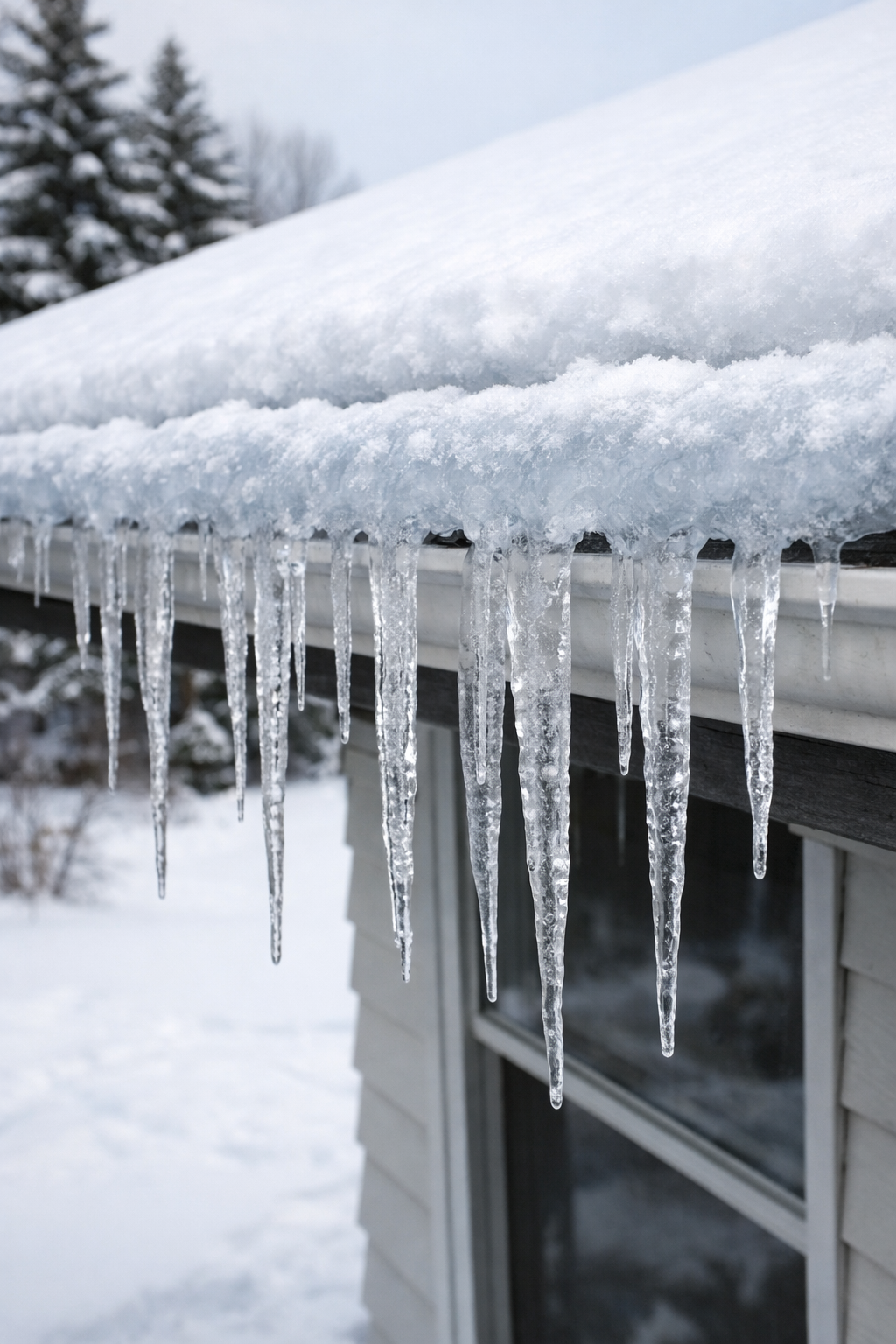
Icicles look pretty. The ridge of ice behind them doesn’t get the same reaction, but it’s the one doing the damage — it’s an ice dam, and it’s forcing meltwater backward, up and under your shingles, instead of off the roof where it belongs. Here’s how that actually happens, and why the fix most people reach for (a roof rake, every storm, all winter) never touches the real cause.
Why an ice dam forms in the first place
An ice dam isn’t about how cold it is outside — it’s about heat you’re paying to lose. Warm air leaks up out of the living space into the attic (around recessed lights, the attic hatch, bathroom fans, plumbing stacks), and that heat warms the roof deck from underneath. The upper roof, over the warm part of the attic, melts the snow sitting on it. That meltwater runs down the slope until it reaches the overhang past the exterior wall — the part of the roof that’s no longer over heated space, so it’s still cold. The water refreezes right there, at the eave. Every cycle through a freeze-thaw day adds another layer. That’s the dam.
How the water actually gets inside
A normal roof sheds water downhill because shingles are designed to overlap like fish scales, relying on gravity. An ice dam breaks that assumption. Once there’s a ridge of ice sitting at the eave, the meltwater running down from above has nowhere to go — it pools behind the dam instead of draining past it. Standing water doesn’t care about shingle overlap; given enough depth and enough time, it works its way up and under the shingle edges through capillary action, finds a seam, a nail hole, or a transition at a valley or chimney flashing, and that’s the leak. This is why ice-dam leaks often show up well inside the house, near an exterior wall, not right at the roofline where you’d expect a leak to start.
What NOT to do
Don’t chip the ice off with an axe, hammer, or ice pick. It feels productive and it tears the shingles underneath, which trades a temporary ice problem for a permanent roof problem. Don’t use a blowtorch or open flame — it’s a genuine fire risk against a wood roof deck and asphalt shingles. Don’t climb onto a snow- and ice-covered roof to deal with it from above; that’s how falls happen.
What actually helps right now
A calcium-chloride ice-melt sock, laid across the dam perpendicular to the roof edge (a pair of old pantyhose or a long fabric tube filled with calcium chloride works fine — skip rock salt, which can damage gutters and metal flashing), melts a channel through the dam so water has somewhere to drain. It’s a reactive fix for the storm you’re in, not a cure, but it’s genuinely safe and it works. A roof rake, used from the ground to pull snow off the lower few feet of roof after a storm, reduces how much snow is available to melt and refreeze in the first place — worth doing, but it’s prevention for the next dam, not a fix for one already formed.
The real fix: stop losing the heat
Ice dams are fundamentally an attic problem wearing a roof problem’s clothes. If the whole roof deck stayed close to outdoor temperature — attic air-sealed from the living space below, and enough soffit-to-ridge ventilation to flush out whatever heat does make it up there — snow wouldn’t melt unevenly, and there’d be no warm meltwater reaching a cold eave to refreeze. Heat cable along the eave is a common patch homeowners install, and it does work while it’s running, but it’s an electric bill forever, not a fix — it treats the symptom at the exact spot the attic problem keeps causing. Air-sealing the attic floor and confirming adequate ventilation is the one-time fix that actually changes the physics.
Signs a dam already got water inside
Watch for a water stain on the ceiling near an exterior wall (not centered in the room — that pattern specifically points to an eave-area leak, not plumbing), peeling or bubbling paint along the same area, or a gutter visibly pulled away from the fascia under the weight of accumulated ice. Any of those means this winter’s dam already did something; it’s worth getting the attic looked at before the next one.
Not sure what you’re looking at?
Send me a photo of the ice buildup, or of the stain if you’re already seeing one inside, and I’ll tell you whether this is a melt-it-now situation, a gutter problem, or signs the attic needs air-sealing before the next storm. A written diagnostic with the specific read, $19.99, back to you in minutes.