I’ve owned and rebuilt houses with foundations ranging from 1920s fieldstone to poured concrete. I’ve panicked over cracks that turned out to be nothing, and I’ve also watched a homeowner ignore the one crack that actually mattered until it cost him $30,000.
Here’s the thing about foundation cracks: almost all of them are cosmetic, and the foundation repair industry makes its money convincing you they’re not. A “free foundation inspection” from a company that sells piers is a sales call, not a diagnosis. So before you sign anything, you need to know which signs actually mean structural movement and which ones just look scary.
Here are the five that mean get a real opinion, and at the end, the two that send people into a panic for no reason.
Sign 1: Stair-step cracks in block or brick, wider than a quarter inch
A crack that runs diagonally through a concrete-block or brick wall in a stair-step pattern — following the mortar joints up and over, up and over — is the classic signature of differential settlement. One part of the foundation is sinking faster than the rest, and the wall is tearing itself apart along its weakest line.
The width is what matters. A hairline stair-step you can barely catch a fingernail in has probably been there for decades and stopped moving. A stair-step crack you can fit a quarter into, or one that’s wider at the top than the bottom, means active movement. That’s an engineer call.
What I’d do: mark each end of the crack with a pencil line and write the date next to it. Measure the width with a ruler. Check again in 30 days. If it’s grown, it’s active.
Sign 2: Doors and windows that suddenly stick or won’t latch
Houses move a little with the seasons — that’s normal. What’s not normal is a door that always closed fine suddenly dragging at the top corner, or a window that won’t latch where it used to, or a visible gap opening at the top of a door frame.
When a foundation settles unevenly, it racks the framing above it out of square. The first place you feel that is the doors and windows, because they’re the only moving parts in a wall. One sticking door is humidity. Three sticking doors all on the same side of the house is the foundation talking.
Sign 3: Horizontal cracks or a bowing basement wall
This is the one that actually scares me, and it’s the one homeowners most often miss because it’s down in the basement behind the storage shelves.
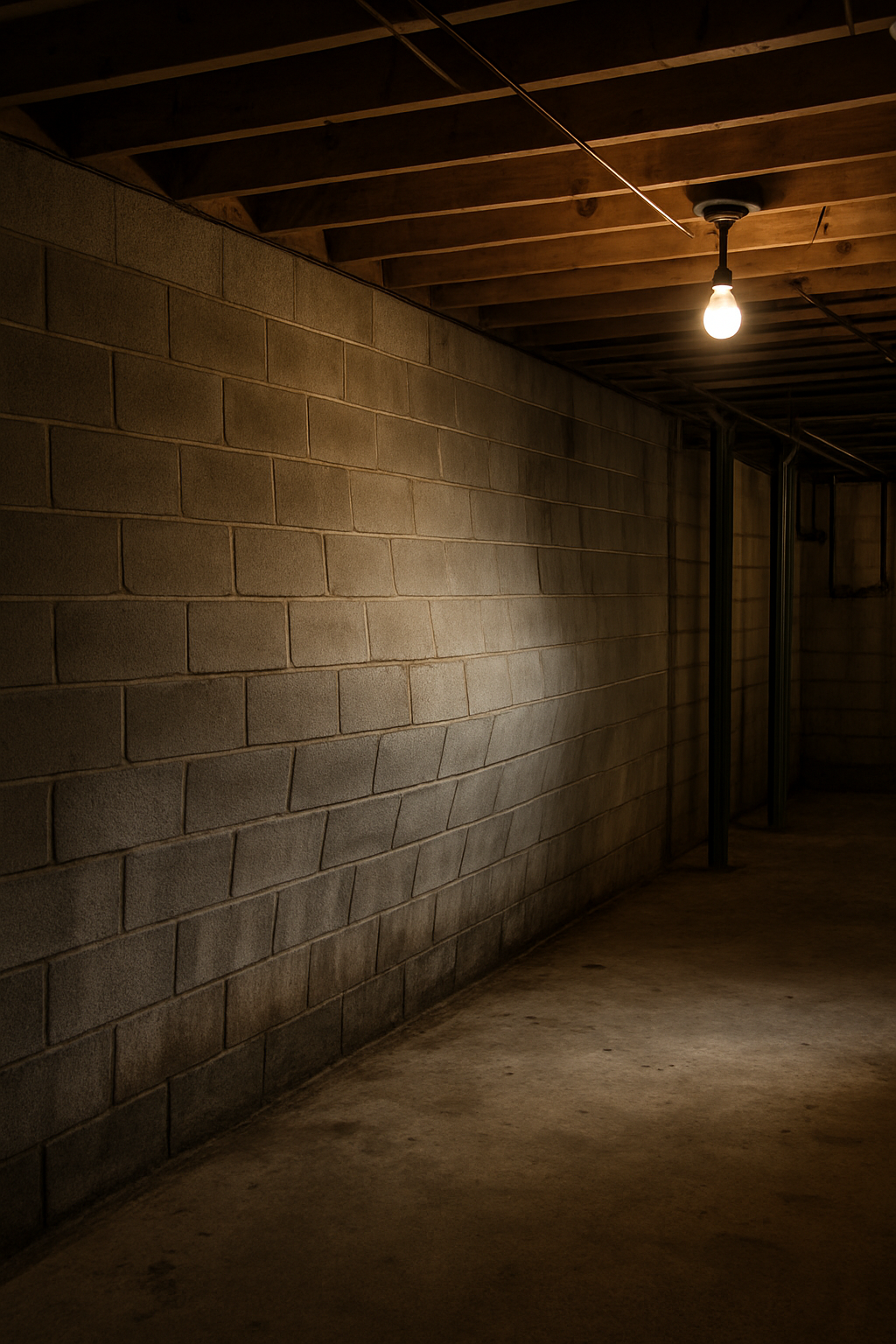
A horizontal crack running across a basement wall — especially a block wall, especially around the middle third of the wall’s height — is not settlement. It’s the soil outside pushing in. Hydrostatic pressure and frost are bending the wall inward like a soda can. If you put a straightedge or a string against the wall and see it’s bowed in even half an inch, that wall is failing in a way that gets worse every wet season.
Vertical cracks are usually fine. Horizontal cracks and bowing are the emergency. If you find one, stop reading and call a structural engineer this week.
Sign 4: Floors that slope, sag, or bounce
Grab a marble, or a golf ball, or use a 4-foot level. Set it on the floor in a few rooms. A little slope in an old house is character. A floor that drops an inch or more across a single room, or a spot in the middle of a room that visibly sags and bounces when you walk it, is telling you the support underneath has moved — a settled footing, a rotted girder, a failed support post, or a foundation that’s dropped on one side.
This one isn’t always the foundation perimeter — sometimes it’s a center beam or a crawlspace post. But it’s the same family of problem, and the diagnosis sequence is the same: figure out what’s below the low spot before anyone “fixes” the floor.
Sign 5: The foundation pulling away from the house
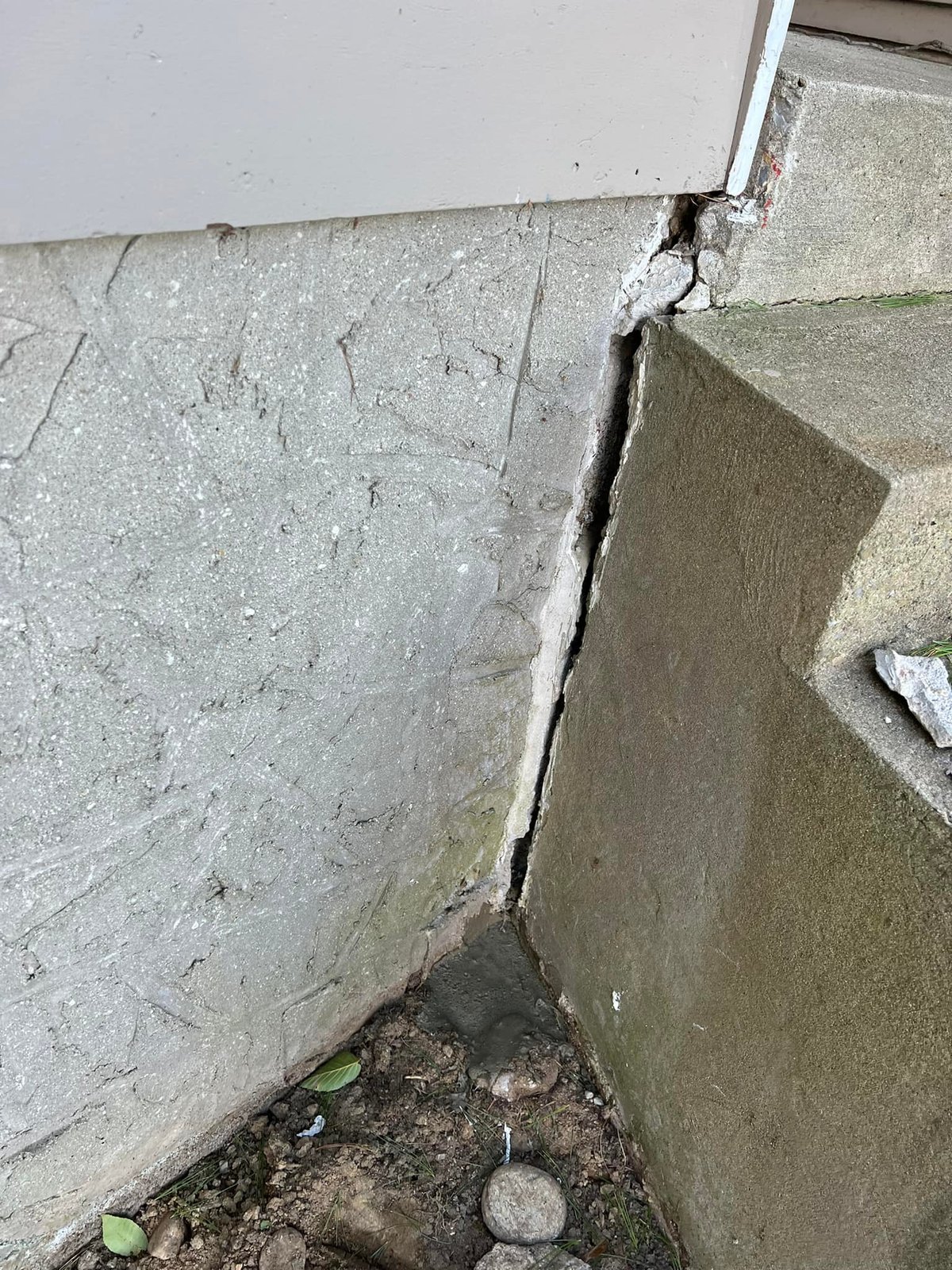
Walk the outside. Look at where the brick veneer meets the windows, where the foundation meets the front steps, where the chimney meets the wall. You’re looking for separation — a gap that’s opened up between two things that used to be tight together.
A chimney leaning away from the house. A gap behind the front stoop. A garage door frame that’s no longer square so the door wedges in the corner. Brick veneer cracking and stepping away from a corner. These are all the exterior version of the same story: one part of the structure is going somewhere the rest of it isn’t.
The 2 that look scary but usually aren’t
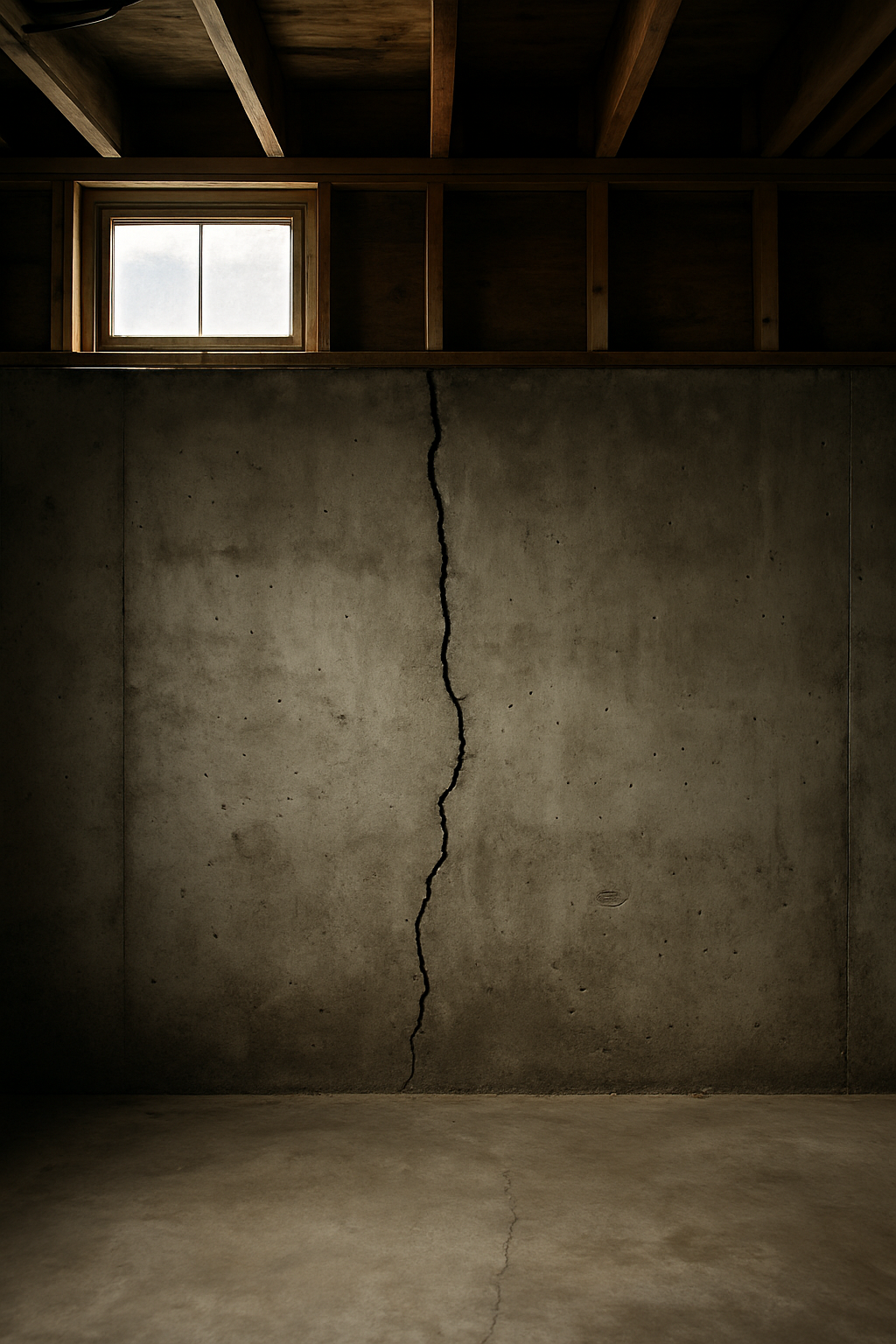
Hairline vertical cracks in poured concrete. Poured concrete foundations shrink as they cure, and they almost always develop thin vertical cracks in the first year or two. They look alarming in a flashlight beam. They’re shrinkage, not failure. If one’s leaking water you seal it — but it’s not a structural problem.
Spider-web cracks in the surface of a slab or wall. Fine, shallow cracking across the surface of concrete — called crazing or map cracking — is a finishing and curing issue. It’s cosmetic. It does not mean the slab is breaking up underneath.
The difference between cosmetic and structural is the difference between a $40 tube of crack sealer and a $25,000 pier job. Don’t let anyone blur that line to sell you the pier job.
How to apply this before you spend a dime
- Don’t start with a foundation repair company. Their inspection is free because it’s a sales tool. Start with an independent structural engineer — a few hundred dollars for an unbiased report you can hand to any contractor.
- Document before you panic. Mark and date your cracks, measure the widths, check in 30 days. Active movement is the deciding factor, and you can only see it over time.
- Triage by type. Horizontal cracks and bowing walls = this week. Stair-step cracks that are growing = soon. Hairline vertical cracks in poured concrete = relax.
Want me to look at your foundation?
If you’ve got a crack that’s keeping you up at night, send me three photos for a $19.99 diagnostic report — a wide shot of the wall, a close-up of the crack with something for scale next to it (a coin or a ruler), and a shot of any sticking door or sloping floor.
I’ll tell you which bucket it falls in — cosmetic, monitor, or get-an-engineer-now — and what to ask for so you don’t get sold a repair you don’t need.
You can also see foundation and structural work I’ve done — repointing, repair, and rebuild — for a sense of what the real fixes actually involve.
The most expensive foundation mistake isn’t the repair. It’s paying for a repair you never needed — or ignoring the one you did.