A wood deck left untreated lasts 8–12 years before the boards need replacement. A wood deck that gets cleaned and sealed on schedule lasts 25–30 years. The math on this is wild — three or four weekends across a deck’s life adds two decades to its lifespan and avoids a $5,000–$15,000 replacement.
Most homeowners skip it because they think it’s complicated. It’s not. The whole job is two days: one to clean, one to seal. Maybe a weekend in spring or fall.
Here’s the full sequence I use.
When to Clean and Seal
Quick test: water test. Sprinkle water on the deck boards. If the water beads up and sits there, your sealer is still working. If the water soaks into the wood within 60 seconds, the sealer is gone — time to reseal.
Schedule (rough rule):
- First time on a new deck: Wait 30-90 days after install for the wood to dry and weather slightly (sealer won’t bond to fresh-from-the-mill wood).
- After that: Every 2-3 years for transparent stains; every 4-5 years for solid stains.
- Cleaning only (no sealing): Annually as part of spring opening — clears mildew, leaves, and dirt buildup.
Best time of year: Spring (April-May) or fall (September-October). Avoid hot summer (sealer flashes off too fast) and winter (won’t cure).
Stripping vs. Cleaning vs. Brightening
The three terms get confused in the store. Here’s what each does:
Cleaner: Removes dirt, mildew, algae, and mold. Used on all decks, every year. Sodium percarbonate-based (oxygen bleach) is the safe DIY standard.
Stripper: Removes the previous sealer or stain. Only needed when changing color/type of finish, or when the existing finish is failing badly. Sodium hydroxide (lye) based — aggressive.
Brightener: Restores wood color after cleaning or stripping (which leaves wood looking dull or grayish). Oxalic acid based.
For a typical maintenance cycle: cleaner + brightener is what you want. Skip the stripper unless you’re changing finish types.
Tools and Materials
- A garden pump sprayer ($15)
- A medium-stiff scrub brush on a long pole, or a deck-cleaning brush ($25)
- A pressure washer (rented for $50/day, optional but speeds the job)
- Deck cleaner (Wolman’s Deck Brite, Cabot Problem-Solver, or Scotts OxiClean Deck Cleaner)
- Deck brightener (Wolman’s Deck Brightener)
- Deck sealer or stain (your choice — see below)
- A 9-inch roller frame, low-nap roller covers
- A 3-inch brush
- 5-gallon bucket
- Drop cloths to protect plants and patio
- Rubber gloves and safety glasses
- Old clothes (cleaner and stain stain)
Pick Your Finish Type
Three categories of deck finish, each with tradeoffs:
Transparent / clear sealer (Olympic Maximum Clear, Thompson’s WaterSeal): Lets the natural wood grain show through. Lasts 1-2 years. Best for new decks where you want to maintain the wood color.
Semi-transparent stain (Cabot, Behr DeckPlus, Olympic Elite): Adds color tint while still showing grain. Lasts 2-4 years. Best balance of looks and durability for most decks.
Solid stain (Sherwin-Williams SuperDeck, Behr Premium Solid): Looks like paint — covers the grain entirely. Lasts 4-7 years. Best for older decks where the wood is no longer attractive on its own. Hardest to remove if you change your mind later.
For most maintenance jobs: semi-transparent. Forgiving, looks good, reasonable lifespan.
Step 1: Prep the Deck (1 hour)
- Remove all furniture, plants, and obstacles. The deck has to be completely clear.
- Sweep thoroughly. Get every leaf, twig, and pile of debris.
- Inspect the boards. Walk every board. Look for:
- Loose screws or nails (drive them flush)
- Splintered or cracked boards (replace before sealing — sealer over a damaged board doesn’t fix the board)
- Rotted spots (poke with a screwdriver — anything that gives way needs replacement)
- Cover plants and shrubs around the deck with drop cloths. Cleaner is harsh on plants.
- Wet plants thoroughly with water before covering — diluted any spray that does land.
Step 2: Apply Cleaner (1 hour + dwell time)
- Mix the cleaner per label directions (usually a powder + water).
- Pour into a pump sprayer or apply with a watering can.
- Apply liberally to one section at a time — start at the high point, work toward the low point.
- Let dwell 15-20 minutes (per label). Don’t let it dry — keep it wet by misting with a hose if needed.
- Scrub with the long-pole brush, working with the grain of the wood.
- Rinse thoroughly with a garden hose or a low-pressure setting on a pressure washer.
- Repeat for each section.
If using a pressure washer:
- Set to LOW pressure (1500-2000 PSI max for wood)
- Use a 25-degree fan tip
- Hold 12-18 inches from the wood
- Move with the grain, never against
- Don’t dwell on any one spot — keep the tip moving
Pressure washing is fast but easy to overdo — gouged boards from too-close pressure-washer use are a permanent visual problem.
Step 3: Apply Brightener (30 min + dwell)
- After the deck is rinsed, wait 1-2 hours for surface moisture to dry. Wood should be damp but not wet.
- Mix brightener per label.
- Apply same way as cleaner — sprayer or watering can.
- Let dwell 10-15 minutes.
- Rinse thoroughly.
- Let the deck dry completely — at least 24 hours, longer if humidity is high. Wood moisture content should be under 15% before sealing.
Step 4: Apply Sealer or Stain (3-4 hours + dry time)
- Stir the sealer/stain thoroughly. Don’t shake — it introduces bubbles. Stir from the bottom up.
- Pour into a paint tray or 5-gallon bucket.
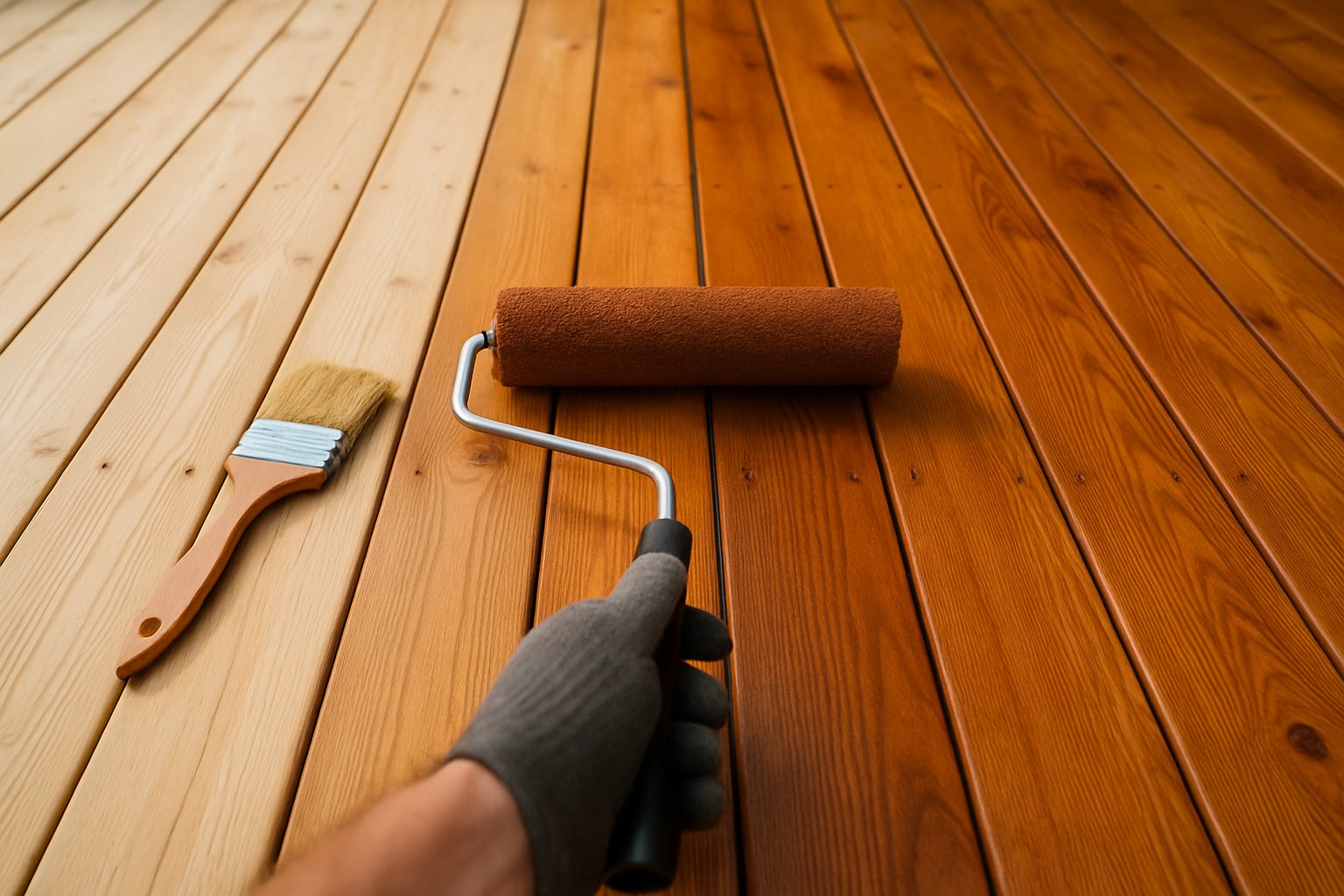
- Apply with a low-nap roller — 9-inch frame, 3/8” or 1/2” nap microfiber. Brush for the edges and between boards.
- Work in 3-4 board widths at a time. Apply with the grain.
- Don’t apply too much. Excess pools and turns sticky. The sealer should soak into the wood — if you’re seeing wet shiny puddles after 5 minutes, you’re applying too thick. Wipe excess with a rag.
- Maintain a wet edge — never stop in the middle of a board, only at the natural break between boards.
- Apply uniformly across the whole deck in one session. Don’t take a long break and resume — the line shows.
- Don’t apply in direct hot sun. The sealer flashes off too fast and doesn’t penetrate. Work in shade or in early/late hours.
- Let dry per label — typically 24-48 hours before walking on the deck.
Common Mistakes
- Skipping the brightener. Cleaner alone leaves wood looking dull and grayish. Brightener restores color in 10 minutes and dramatically improves the look of the finished sealing.
- Sealing damp wood. Sealer over damp wood traps moisture inside, which leads to rot. Always let the deck dry fully — moisture meter readings under 15% before sealing.
- Applying too thick. Causes peeling, sticky residue, and looks splotchy. Multiple thin coats are vastly better than one thick coat.
- Pressure washing too aggressively. Gouges show forever. Stay under 2000 PSI, keep moving, hold 12+ inches away.
- Sealing in direct sun. Sealer dries on the surface before it can penetrate. The wood gets minimal protection.
- Walking on the deck before full cure. Marks the finish permanently. Read the label cure time, then add another 12 hours for safety.
- Using interior products outside. Interior stains and sealers fail in months outside. Always use products labeled “exterior” or “deck.”
When to Call a Pro
- The deck is more than 1500 square feet (DIY becomes a multi-weekend slog).
- You need to replace more than 5-6 boards before sealing.
- You’re going from a transparent finish to a solid stain or vice versa (involves stripping, which is messy and time-consuming).
- You don’t want to deal with the cleanup of a pressure washer, drop cloths, and chemical disposal.
For typical residential decks under 600 square feet, this is genuinely a weekend DIY job.
Frequently Asked Questions
Composite decks — do they need this too? Composite (Trex, TimberTech, Fiberon) needs cleaning but not sealing. Annual cleaning with a composite-specific cleaner removes mildew and stains. No sealer applied.
My deck is gray and weathered. Can I bring it back? Yes — that’s exactly what cleaner + brightener does. The gray is oxidation, not staining. Cleaner + brightener restores most of the original wood color.
How much sealer do I need? Most products cover 200-300 square feet per gallon. A 250 sq ft deck needs about 1 gallon for one coat.
What about deck oil vs. sealer vs. stain? Deck oils penetrate the wood and don’t form a film — easier to maintain, shorter lifespan (1-2 years). Sealers form a thin film that water beads off (medium lifespan, 2-4 years). Stains are pigmented sealers (longest lifespan, 3-5+ years). Pick based on how often you want to redo it.
The Bottom Line
A wood deck that gets cleaned and sealed on schedule lasts 2-3x longer than one that doesn’t. The job is one weekend in spring or fall. The materials are $80-$120. The labor saves you from a $5,000+ deck replacement somewhere down the line. Hard to argue with the math.
For the full sequence including board replacement, joist inspection, and the railing/stair detail work, see Clean and Seal a Deck.
For deck rebuilds, repairs to rotted joists or framing, or planning a new deck, send your photos for a $19.99 diagnostic report.