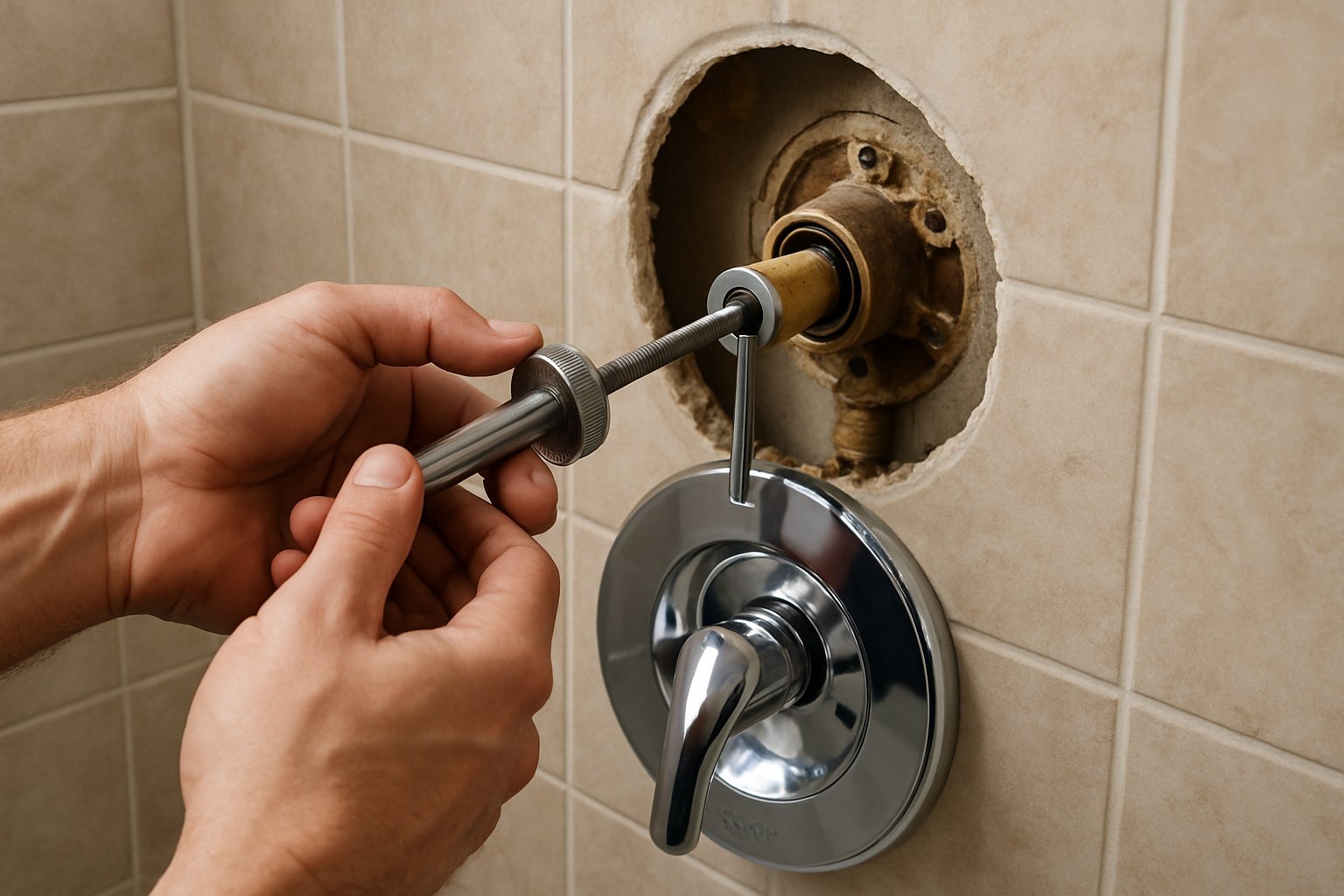
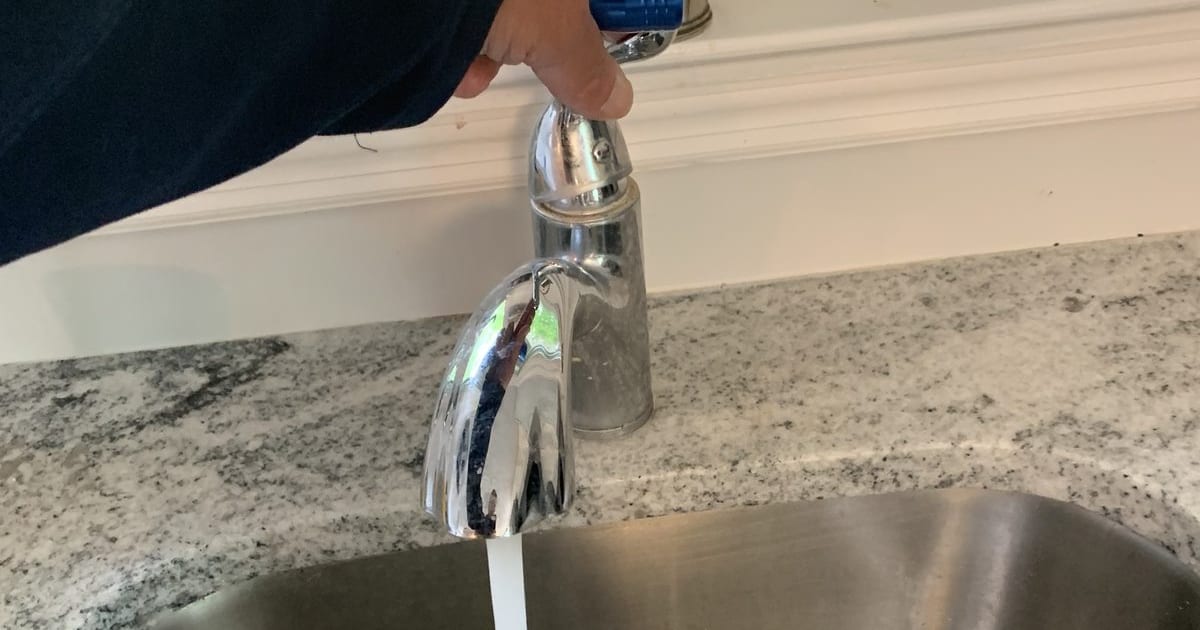
The fix for a leaky faucet depends entirely on the faucet type. Cartridge faucets need a new cartridge ($15–$30). Compression faucets need new washers ($2). Ball faucets need a kit ($20). Ceramic disc faucets almost never fail — when they do, they need a new disc cartridge ($30).
99% of leaks happen because a single rubber seal, washer, or cartridge has failed. Here’s how to identify your faucet, buy the right part, and stop the drip in one trip to the hardware store.
First: Identify Your Faucet Type
There are four types, and each fixes differently.
Compression — two separate handles (hot/cold) that you screw down to shut. Common in pre-1990 homes. Drips because of worn rubber washers.
Cartridge — can be single-handle or two-handle. The handle lifts up to turn on, left/right for temperature. Most common style in bathrooms built after 2000.
Ball — single handle, with a ball mechanism inside. Common on Delta/Peerless kitchen faucets from the ’90s–2010s. The handle moves in a wide range of directions.
Ceramic disc — single handle that slides in a narrower arc. Premium faucets (Moen, Kohler, Grohe) use these. They rarely fail.
Not sure? Take a photo of the faucet and search the brand + model. Most brands stamp the model number on the underside of the spout or on the hot/cold base.
Before You Start: Shut Off Water
Find the angle stops under the sink — two small valves on the supply lines feeding the faucet. Turn both clockwise until they stop. Open the faucet to confirm the water is off before disassembling anything. Plug the sink drain with a rag so you don’t lose small parts.
Fix 1: Compression Faucet (Two Handles, Pre-2000 Home)
Tools: Adjustable wrench, flat-head screwdriver, Phillips screwdriver, pliers with tape on the jaws (to avoid scratching chrome).
Parts: A washer assortment kit ($3) and O-ring assortment ($3).
- Pop off the decorative handle cap (usually labeled H or C). Unscrew the handle screw. Lift the handle off.
- Unscrew the packing nut under the handle with a wrench.
- Unscrew the stem (turn counterclockwise — it unthreads out of the faucet body).
- At the bottom of the stem, there’s a brass screw holding a rubber washer. Unscrew it. Replace the washer with a matching size.
- While you’re in there, replace the O-ring on the stem body too.
- Reassemble in reverse order. Don’t overtighten — you’ll crush the new washer.
- Turn water back on. Test.
Fix 2: Cartridge Faucet (Most Common)
Tools: Allen wrench (usually 7/64 or 3/32), Phillips screwdriver, needle-nose pliers.
Parts: A new cartridge specific to your faucet brand/model ($15–$30). Moen 1225, Delta RP19804, Kohler GP500520 are common numbers — match exactly.
- Turn off water at the angle stops.
- Find the small set screw on the handle (usually on the underside or back). Loosen it with the Allen wrench.
- Pull the handle straight up and off.
- Remove the retaining clip or nut holding the cartridge in place (varies by brand).
- Pull the cartridge straight up with needle-nose pliers. This can require significant force — old cartridges fuse with minerals. If it won’t budge, soak the area with white vinegar for 30 minutes.
- Install the new cartridge — note the orientation (there’s usually a tab or flat side that must align).
- Reinstall the retaining clip, handle, and set screw.
- Turn water back on slowly. Test both hot and cold.
Fix 3: Ball Faucet (Delta/Peerless Kitchen)
Tools: Allen wrench, channel lock pliers.
Parts: A Delta/Peerless repair kit (Delta RP3614 for most) — includes springs, seats, cam, and washers. $15.
- Turn off water.
- Loosen the set screw under the handle, lift handle off.
- Unscrew the cap and collar by hand (or use channel locks with tape on jaws).
- Pull out the ball and cam assembly.
- At the bottom of the faucet body, you’ll see two small springs with rubber seats on top. Pull them out with needle-nose pliers.
- Install the new springs and seats from the kit.
- Reinstall the ball, cam, collar, and cap.
- Turn water back on. Test.
Fix 4: Ceramic Disc Faucet
Tools: Allen wrench, Phillips screwdriver.
Parts: Replacement ceramic disc cartridge ($25–$40) specific to your faucet.
These rarely fail. If yours is dripping, it’s usually debris stuck between the discs, not failure. Disassemble, clean, reassemble.
- Turn off water.
- Remove handle (set screw, usually Allen).
- Unscrew the escutcheon (decorative cap).
- Remove the mounting screws holding the disc cartridge in place.
- Lift out the cartridge.
- Flip it over. If you see sand, sediment, or debris — wipe and rinse. Reinstall.
- If the ceramic surfaces are scored, replace the entire cartridge.
Common Mistakes
- Skipping the O-rings. Replace O-rings at the same time as the washer or cartridge. They’re cheap and they’re the second-most-common leak point.
- Wrong-size washer. Washers come in dozens of sizes. Bring the old one to the store and match it exactly.
- Overtightening. Modern faucets are mostly plastic internals. Hand-tight with a quarter turn of wrench is plenty.
- Not turning the water on slowly. If you’ve got debris in the line from the repair, a full-blast turn-on drives it into the new cartridge and clogs it. Crack the valve slowly.
- Buying a generic cartridge for a branded faucet. Generics fit loosely and leak within months. Get the brand-matched part.
When to Replace the Whole Faucet
If your faucet is over 20 years old, the decorative finish is peeling, or you can’t find parts — replace the whole faucet. A mid-range ($80–$150) faucet lasts 15+ years. A bargain ($30) faucet is a false economy; internals fail fast.
Replacement is DIY-friendly — same water shutoff, same supply line connections. Budget 60–90 minutes for a first-time faucet swap.
Frequently Asked Questions
How much water does a dripping faucet waste? A single drip per second wastes about 3,000 gallons per year — roughly $20–$30 on a water bill, plus the sewer charge in most NJ towns.
Why does my faucet drip only when hot water is on? The hot-side cartridge or washer has failed, not the cold. On two-handle faucets, repair only the side that leaks. On single-handle cartridge faucets, replace the whole cartridge — it handles both.
My shutoff valve won’t turn. What do I do? Don’t force it — you’ll break the stem and have a bigger flood. Turn off the main water to the house, then replace the angle stop valve itself before tackling the faucet.
Can I replace a cartridge without turning the water off? No. Water pressure will shoot the cartridge out of the faucet body like a projectile the moment you loosen the retaining clip.
How often should I replace a faucet cartridge? Most last 8–15 years. Hard water shortens that to 4–6 years.
The Bottom Line
Identify the faucet type, buy the brand-matched part, and follow the disassembly order in reverse for reassembly. Every faucet repair uses the same flow — shut off water, remove handle, remove internals, replace the failed part, reassemble.
If you’re planning a kitchen or bathroom remodel and want a fixture plan, plumbing layout, and permit checklist tailored to your project, send your photos for a $19.99 diagnostic report.