A washing machine that walks across the floor, shakes the wall it’s against, or rattles the whole house during the spin cycle has one of three problems: the feet aren’t level, the load is unbalanced, or the internal shock absorbers are failing.
The first two are free 5-minute DIY fixes. The third is a real repair. Diagnosing which is yours takes 60 seconds.
Here’s the process.
Diagnose First
Test 1: Level the unit and see if the problem stops.
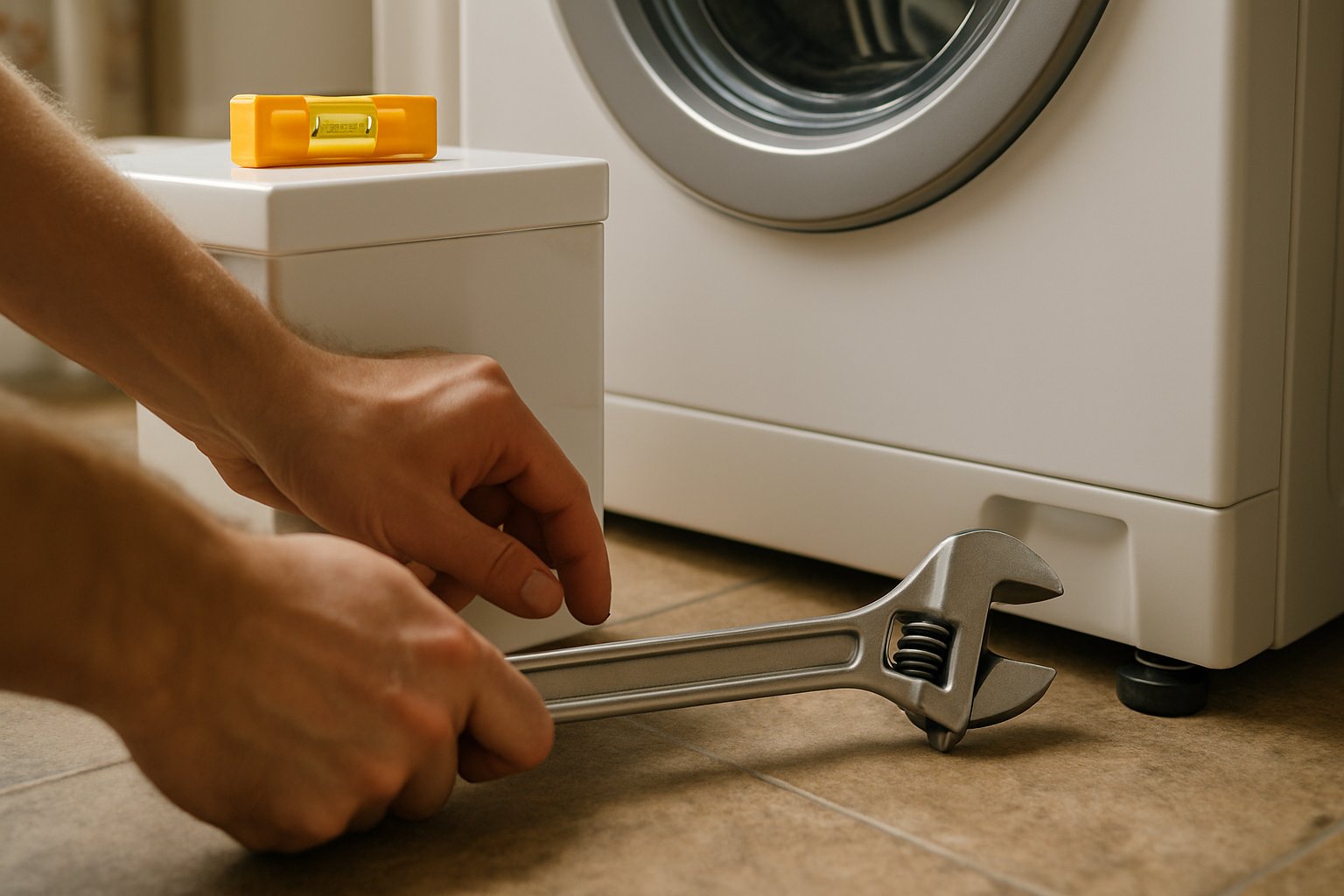
Place a bubble level on top of the washer. Check side-to-side AND front-to-back. If either direction shows the bubble outside the lines, that’s likely your problem. Skip to “Level the Feet” below.
Test 2: Run an empty cycle.
If the washer shakes violently with NOTHING in it, internal shock absorbers or suspension springs are failing. This is a real repair (or replacement decision).
Test 3: Run with a normal load and observe.
If the washer is fine empty but shakes only with a load — and especially when the load is “lumpy” (one heavy item, like a single comforter) — it’s a load balance issue, not a machine issue. The fix is loading the washer differently.
In summary:
- Off-level → fix the feet
- Empty + violent shake → mechanical repair
- Loaded shake only → balance the load
Level the Feet
Most washers have 4 adjustable feet — 2 in front, 2 in back. Front feet are the easy ones to access; rear feet on most machines are “self-leveling” (spring-loaded) but sometimes need help.
Tools:
- Adjustable wrench
- Bubble level (or a smartphone level app)
- A friend (helpful for tilting the machine)
Front feet (manual adjust):
- Pull the washer away from the wall enough to access the front.
- Each front foot has a locknut at the top of the threaded shaft. Loosen the locknut with a wrench.
- Twist the foot up or down to raise/lower that corner.
- Aim for the bubble level to read centered both side-to-side and front-to-back.
- When level, retighten the locknut against the foot.
Rear feet (self-leveling, but sometimes stuck):
- Tilt the front of the washer up about 6 inches (need a friend or shim to hold it).
- The rear self-leveling feet should drop down to floor contact automatically.
- Lower the washer back down. The rear feet should be at the right height now.
- If they don’t self-adjust: spray a little WD-40 on the foot’s mechanism and try again.
Verify the Floor Is Level
Sometimes the washer is level but the floor isn’t. A washer on a sloped basement floor will always struggle to drain properly and may walk during spin.
For a sloped floor:
- Use shims under the washer (rigid plastic or rubber shims). Never use cardboard or wood — they compress over time.
- Level the washer on top of the shims.
- Check that the shims aren’t compressed by the weight — if they are, use rigid plastic next time.
Balance the Load
A washer with one heavy item (a comforter, a wet rug, a pile of jeans) creates an unbalanced load that shakes during spin. Modern washers detect this and either:
- Slow the spin to attempt balance
- Stop and beep (load-balance error)
- Just shake violently
Fixes:
- Add a couple of towels or a pair of jeans to balance a heavy single item.
- Don’t wash large items alone — pair with smaller items.
- Distribute the load evenly around the drum (top-loaders) or against the front of the drum (front-loaders).
- For especially heavy items (king-size comforters): take to a laundromat with industrial-size washers; your home washer can’t safely spin it.
When the Shock Absorbers Are Failing
If the washer shakes empty, the internal damping is failing.
For top-loaders: Usually four shock absorbers between the inner tub and the cabinet. They wear out or break.
For front-loaders: Two shock absorbers and four suspension springs.
Cost to repair:
- Parts: $40-$120
- Labor (pro): $200-$400
- DIY: 2-3 hours, doable with patience and the right service manual
For an older machine (8+ years), repair cost approaches replacement cost. Decision point.
Signs the shocks are gone:
- Loud banging during spin
- Visible drum shifting (looks at it through the open lid — it should rotate smoothly, not wobble)
- Empty cycle still shakes the unit
Common Mistakes
- Not checking front-to-back AND side-to-side. A washer level side-to-side but tilted forward will still walk.
- Using cardboard shims. Compresses over time, washer becomes off-level again.
- Ignoring the load balance issue. No amount of leveling fixes a washer that’s only shaking with one heavy item.
- Tightening the locknut without testing the level. Always confirm the level reads correct before locking the foot in place.
- Skipping the back feet. Yes, the rear feet matter. Yes, they’re harder to access. Skipping them is what causes most “front is level but back isn’t” problems.
When to Replace the Washer
- Empty cycle still shakes after leveling and shock absorber inspection
- Repair quotes exceed 50% of a new washer
- Washer is 10+ years old AND has multiple symptoms (shaking + leaking + electrical issues)
A new mid-range washer is $500-$900. Repair beyond $300 on an old machine usually doesn’t pay back.
The Bottom Line
A walking or shaking washer is most often a leveling issue — a 5-minute fix that requires only a wrench and a level. Load balance is the next most common cause. Mechanical failure is real but rarer. Always diagnose before assuming the washer is broken.
For the full sequence including stacked washer/dryer leveling, the pedestal install scenarios, and the shock absorber repair walkthrough, see Level a Washing Machine.
For a laundry-room remodel or replacing a stacked washer/dryer with a new configuration, send your photos for a $19.99 diagnostic report.