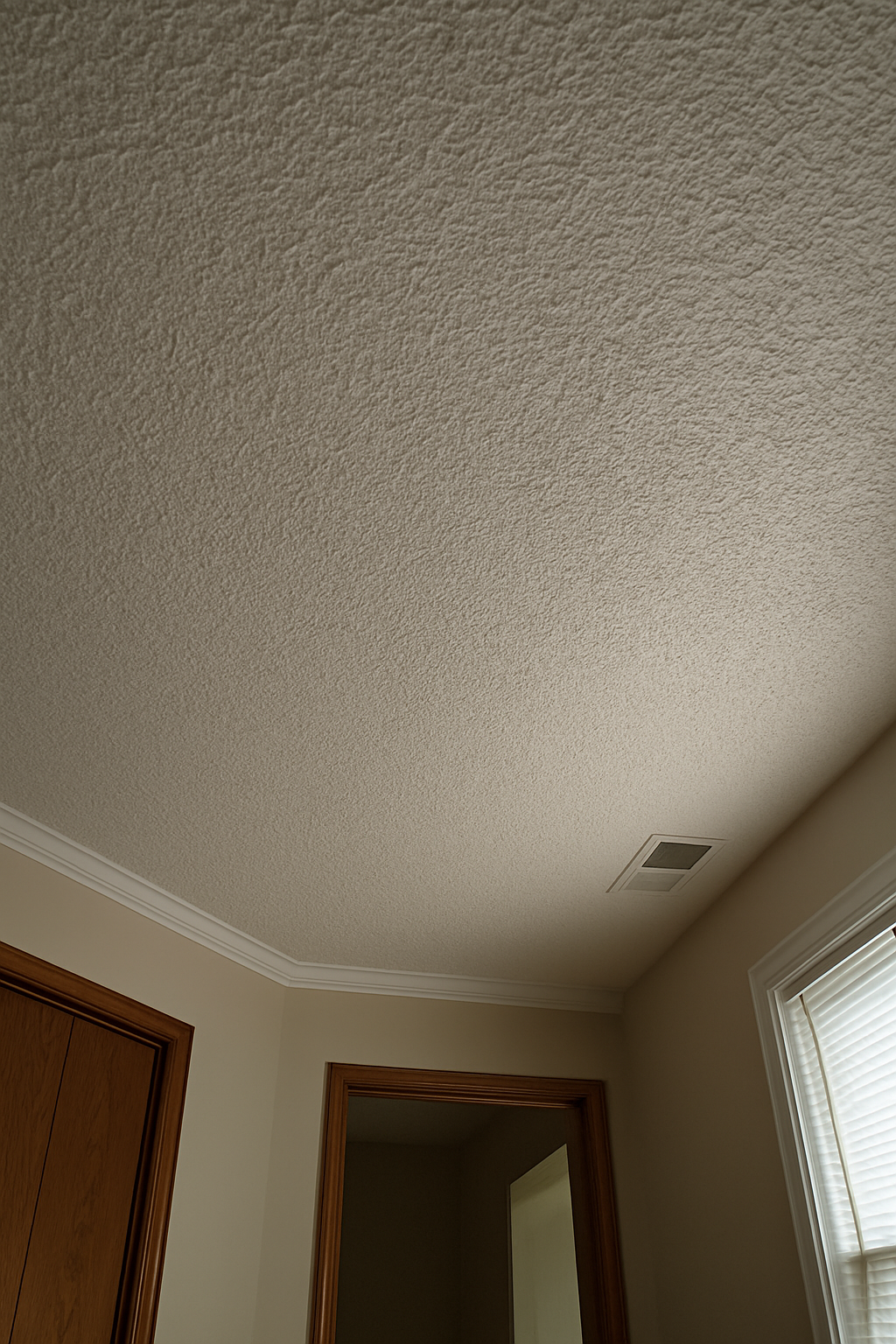
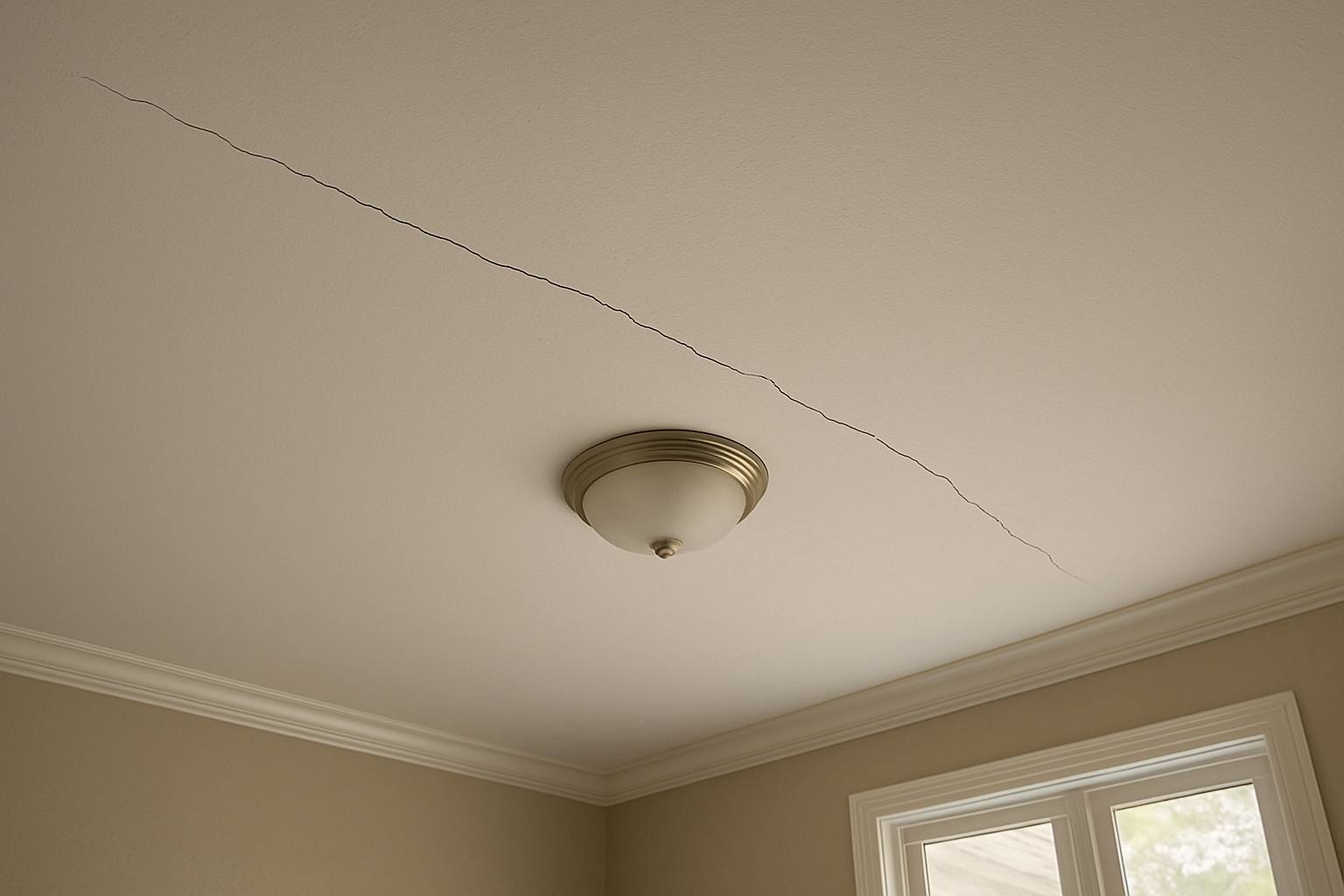
You notice it on a Sunday, lying on the couch: a line running across the ceiling that you’re fairly sure wasn’t there before. Within about ten seconds most people have talked themselves into a cracked foundation and a five-figure repair. Take a breath. The large majority of ceiling cracks are the drywall doing what drywall does, not the house coming apart. But a few are worth taking seriously, and the trick is knowing which is which before you either panic or paint over a real problem.
I’ve patched a lot of ceilings and I’ve also opened a few up to find something that actually needed fixing. The difference is almost never the thing people fixate on — how scary the crack looks. A dramatic, jagged crack is often nothing. A short, tidy hairline is occasionally the one that matters. What tells you the truth is where the crack is, what it’s doing over time, and what else is happening in the room.
First, the good news: most of them are cosmetic
Your ceiling is drywall — panels of gypsum screwed to the framing, with the seams taped and mudded smooth. That taped seam is the weakest line up there, and your house moves a little with every change of season: wood framing takes on moisture in summer and gives it back in winter, and everything expands and contracts a hair. The tape telegraphs that movement. So the two most common cracks are both cosmetic:
- A straight, thin crack that follows a seam. Runs in a clean line, sometimes with a faint ridge where the tape sits. That’s a joint that’s had enough seasons of flexing. Annoying, not dangerous.
- Fine “map” or spider cracking, especially in older plaster ceilings. Usually paint buildup and age. Cosmetic.
If that’s what you’ve got — thin, following a seam or spidered across an old plaster field, no sag, no stain — you can stop reading and go get drywall tape. That’s most ceilings.
The seasonal one that fools almost everybody: truss uplift
Here’s one that sends people into a spiral every winter and shouldn’t. If your crack runs along the joint where the ceiling meets an interior wall — and it opens up in the cold months and closes again in summer — that’s very likely truss uplift. The roof trusses in the attic arch upward slightly when the top and bottom of the truss are at different temperature and humidity, lifting the ceiling away from the partition wall below. It looks like the house is splitting. It isn’t. It’s a known, benign behavior of trussed roofs.
You don’t fix truss uplift by re-taping the crack — it’ll just reopen next January. You hide the movement: a crown molding fastened to the ceiling only (not the wall) so the gap opens and closes behind it, out of sight. Cosmetic problem, cosmetic fix.
The three cracks that actually mean trouble
Now the ones I’d want a closer look at.
1. A crack that doesn’t stop at the ceiling. If the line runs across the ceiling and then keeps going — turning the corner and continuing down a wall, especially on a diagonal — that’s no longer a taped-seam story. A crack that travels through the ceiling-to-wall transition is following the framing, and it usually means something is moving: settlement below, a framing problem above, or a span that’s deflecting. One continuous crack across two planes is worth a professional look.
2. A crack with a sag. Put your eye at ceiling level from across the room, or lay a straightedge up there. If the ceiling is bowing downward and cracked, stop treating it as cosmetic. Sag plus a crack can mean water-damaged drywall, plaster whose “keys” have broken loose from the lath, joists that are overspanned for the load, or weight sitting up in the attic that shouldn’t be. Plaster ceilings in particular can let go all at once, and a sagging plaster ceiling is a genuine safety issue. Don’t poke it — get someone under it.
3. A crack that’s displaced or growing. Run a finger across it. If one side sits higher than the other — a little step or offset — that’s differential movement, not just a surface split. Same if it’s wider than about an eighth of an inch, or if you can see it’s lengthening month over month. A static hairline is a scar. A crack that’s still on the move is an active problem, and the width and offset are how it tells you.
And the one that looks completely harmless
This is the one people wave off, and it’s why “how scary does it look” is the wrong test. Picture a thin, neat hairline — the kind you’d barely mention. Two things turn that nothing-crack into a flag:
- It comes back in the exact same place every time you patch it. You tape it, mud it, paint it, and a season later there it is again on the same line. A finish crack that keeps reopening in one spot is the ceiling telegraphing movement underneath — the surface can’t heal over something that’s still shifting.
- It has company. Look down. A door or window in that part of the house that’s started to stick or won’t latch square, a floor that feels like it slopes toward one corner, a hairline that lines up with a crack on the floor above or below. One tidy hairline is nothing. The same hairline plus a sticking door beneath it is two symptoms of the same structural movement, and now it’s worth investigating.
The tell was never the crack’s drama. It’s recurrence and corroboration.
Water is its own category — check for it first
Before you file a crack under “structural,” rule out water. Brown or yellow staining around it, drywall that feels soft or spongy, a musty smell, or paint that’s blistering nearby means you don’t have a movement crack — you have a leak finding its way out through the weakest seam. Roof, a plumbing line above, or condensation from an attic problem. Chasing the crack is pointless until the water’s found and stopped; the crack is just the exit wound.
The ten-minute check
Stand in the room with a flashlight and a pencil and sort it:
- Thin and following a seam, no sag, no stain? Cosmetic. Tape and paint.
- Along an interior wall-ceiling joint, worse in winter? Truss uplift. Crown molding, not re-taping.
- Continues down a wall, or runs diagonal and long? Possible framing/foundation movement. Get it looked at.
- Sagging, soft, or stained? Water or load. Stop, don’t disturb it, get eyes on it.
- Offset, wide, or growing? Active movement — mark and monitor, or call now if it’s paired with sticking doors or sloping floors.
For anything in the “maybe” column, do this: mark each end of the crack with a light pencil tick and write the date next to it, then photograph it once a month. A crack that hasn’t moved in a few months is one you can watch. A crack that’s outrun your pencil marks is one to act on. That single habit answers the question better than any amount of staring.
What I’d do
If it’s cosmetic, it’s a genuinely easy Saturday: mesh tape or paper tape over the seam, two thin coats of joint compound feathered wide, sand, prime, paint. Truss uplift gets molding instead. Neither is a job worth losing sleep over.
If it’s in the trouble column — continuing down a wall, sagging, offset, growing, or stained — resist the urge to skim-coat over it and move on. Covering a moving crack just buys a few months and hides the evidence you’d want later. That’s the moment for a structural engineer or the right trade to tell you what’s actually moving and why.
Not sure which one you’re looking at?
That’s exactly the call I get asked to make. Send me a few photos — the crack itself, a wider shot of the whole ceiling and the wall it meets, and anything nearby that’s acting up like a sticking door. I’ll tell you which of these buckets yours falls in, whether it’s a tape-and-paint afternoon or a get-someone-out situation, and what I’d do if it were my own ceiling: a written diagnostic with the specific next step and honest cost, $19.99, back to you in minutes.