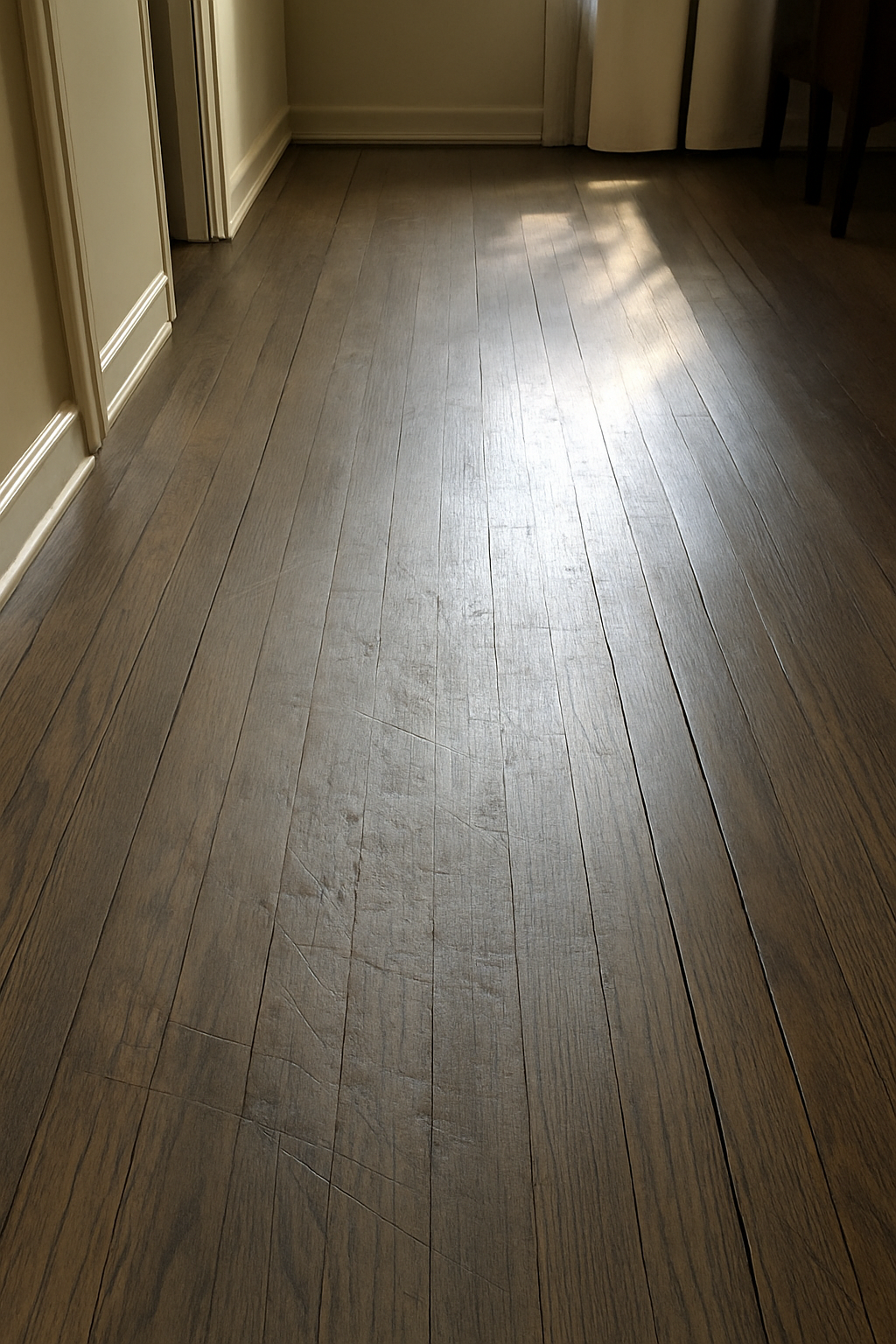
The floors look rough — scratched, gray in the walkways, finish worn through — and someone’s quoted you for a whole new floor. In most houses that’s a mistake worth thousands, because tired hardwood usually refinishes like new: sand off the old finish and the top layer of wood, restain, recoat, and it looks like the day it went in. The catch is that refinishing only works if there’s enough wood left to sand and the boards are still flat and sound. Three things decide it, and one of them means there’s genuinely nothing left to work with.
Here’s how to tell whether you’re looking at a refinish (or an even cheaper recoat) or a real replacement.
Deciding factor 1: how much wood is left to sand
This is the big one. A full refinish removes a thin layer of wood, and a floor can only give that up so many times.
- Solid hardwood (typically 3/4” thick) has a lot of life — it can usually be sanded and refinished several times over its lifespan before you reach the tongue-and-groove.
- But if a floor has already been refinished a few times, look for the warning signs that it’s near the end: nail heads starting to show, the tongue-and-groove edges getting thin, or boards that feel flimsy. Once you’re near the fasteners, there’s nothing left to sand.
Deciding factor 2: solid or engineered?
Know what you actually have, because it changes everything. Engineered flooring is a thin hardwood veneer over plywood, and that veneer is what limits you. A thick wear layer (roughly 2mm or more) can usually be refinished once. A thin veneer often can’t be refinished at all without sanding through to the plywood. If your floor is engineered and the veneer is thin, refinishing may not be an option, and worn or damaged boards get replaced instead.
Deciding factor 3: what kind of damage is it?
Match the fix to the problem:
- Surface wear — scratches, dullness, a grayed-out worn finish, light stains: this is exactly what refinishing fixes. Refinish (or recoat — see below).
- Cupping, crowning, or warped boards from water: the wood has absorbed moisture and moved. Find and fix the source first; sometimes, once it fully dries and re-acclimates, it flattens enough to refinish. Sometimes those boards have to come out.
- Deep black pet stains, rot, or a damaged subfloor: black stains that have soaked through the finish into the wood often won’t sand out, and rot or a soft subfloor means board (or floor) replacement, not refinishing.
The cheaper middle option: screen and recoat
If your finish is worn but the wood underneath is fine — no bare spots, no deep damage — you may not need a full sanding at all. A screen-and-recoat lightly abrades the existing finish and lays a fresh coat on top. It’s faster, cheaper, and far less dusty than a full refinish, and it’s the underrated right answer for floors that are just looking tired rather than damaged. It won’t fix bare wood, deep scratches, or color changes, but for a dull finish it’s a great value.
The decision, simply
Recoat (screen-and-recoat) when the finish is worn but the wood is sound and you like the color.
Refinish when there are scratches, bare spots, or you want a new color — and it’s solid wood with plenty left to sand, or engineered with a thick enough veneer for one pass.
Replace boards or the floor when the wood’s been sanded to its limit, the engineered veneer is too thin, or there’s cupping, rot, deep staining, or subfloor damage that sanding can’t reach.
DIY or not
A screen-and-recoat is genuinely DIY-friendly — a rented buffer, a screen, and a coat of finish. A full sand-and-refinish is doable, but the big drum sanders are unforgiving; a moment of hesitation leaves a gouge or a dish in the floor, and that’s a hard mistake to undo. A lot of people happily DIY the recoat and hire out the full refinish for exactly that reason. Board replacement and matching in new wood is a fussier job — weaving in boards and matching stain and sheen is where it gets tricky.
Not sure which your floors need?
Send me photos — a wide shot, a close-up of the worst wear, and any cupped or stained boards — and tell me if you know whether it’s solid or engineered. I’ll tell you whether you’re looking at a cheap recoat, a full refinish, or replacement, and roughly how much wood you’ve got left to work with: a written diagnostic with the specific plan and honest cost, $19.99, back to you in minutes.