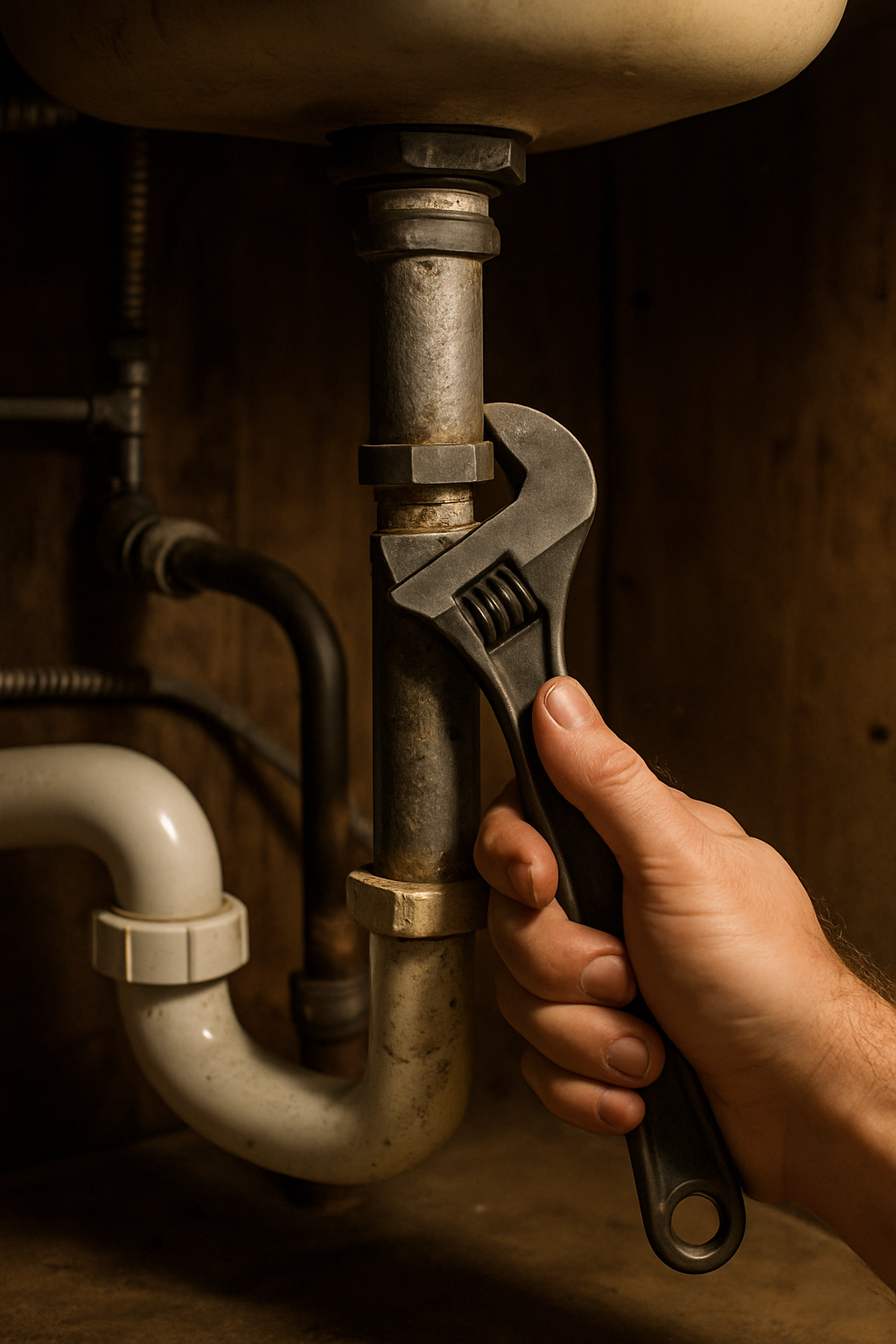
A pipe springs a leak — under a sink, in the basement, wherever — and the fear that jumps straight to mind is the big one: does my whole house need to be repiped? That’s a five-figure job. Most of the time, a single leak is just a single leak, and the fix is a local repair. But there’s a pattern of symptoms that means the pipe material itself is failing throughout the house, and patching one spot at a time just chases the next leak.
Here’s how to tell which situation you’re actually in.
An isolated leak is usually just that
If you’ve got one leak, in otherwise sound pipe (copper or PEX, no other symptoms elsewhere in the house), that’s a local repair — a compression fitting, a section of pipe replaced, a slip coupling. Plumbers do this routinely, and it doesn’t mean anything about the rest of your plumbing. Copper and PEX don’t fail from age the way older materials do; a leak in them is usually a specific cause (a nail through a wall, a bad original joint, a freeze) rather than a system-wide problem.
The material that actually wears out: galvanized steel
If your house has original galvanized steel pipe — common in homes built before the 1960s-70s — that pipe corrodes from the inside, where you can’t see it. Mineral deposits and rust build up on the interior walls of the pipe over decades, progressively narrowing the opening. This shows up as two things together: rust-colored or brown-tinted water, especially noticeable right after the water’s been off for a while, and water pressure that’s been dropping gradually over years — not a sudden drop from one fixture, but a slow squeeze across the whole house as the pipes silt up internally.
Why patching doesn’t fix galvanized corrosion
The leak you’re patching today is one weak point in a pipe that’s corroding uniformly along its whole length. Fix that spot and the next thinnest point fails next, often within a year or two. This is the pattern that means it’s time to talk about repiping — not because one leak is scary, but because the material itself is at the end of its usable life throughout the house, and you’ll be back here repeatedly otherwise.
A special case worth knowing: polybutylene
If your house was built or replumbed between roughly 1978 and 1995, ask whether it has polybutylene pipe — a gray plastic pipe that was popular for a while and turned out to fail from the inside out, often with no warning before a pipe simply bursts. It was the subject of a major class-action settlement, and many insurance companies flag it. If you’re not sure what material your house has, this is worth finding out, independent of whether you’ve had a leak yet.
The decision, simply
Patch it when it’s an isolated leak in copper or PEX pipe with no other symptoms — that’s a normal, bounded repair. Start planning a repipe when you’re seeing rust-tinted water and pressure that’s been dropping for years, which points to galvanized pipe corroding throughout the house — not just at the spot that happens to be leaking today. And if you have polybutylene, get it identified regardless of current symptoms.
DIY or not
A single fitting repair on accessible copper or PEX pipe is within reach for a comfortable DIYer with basic plumbing tools. Diagnosing whole-house pipe material and condition, and any repiping project, is licensed plumber territory — it involves cutting into walls, working around electrical, and getting it wrong means water damage that costs far more than the job itself.
Not sure which one you’re looking at?
Tell me what pipe material you have if you know it, describe the leak, and let me know if your water pressure or color has changed over the years. I’ll tell you whether this looks like an isolated repair or a sign it’s time to plan for a repipe — a written diagnostic with the specific read and honest next step, $19.99, back to you in minutes.