The water’s gone hard again — spots on the glassware, soap that won’t lather, that filmy feeling in the shower — and it feels like the whole softener just died. Before you price a new system, know this: the single most common reason a softener “stops working” isn’t a broken part at all. But there’s a real difference between that and a control valve or resin problem, and knowing which one you’re looking at changes whether this costs you nothing or a few hundred dollars.
Here’s how to tell which situation you’re in.
Check the brine tank first: is it a salt bridge?
A salt bridge forms when humidity and temperature swings cause the salt in the brine tank to fuse into a hard crust above the water line, leaving a hollow air gap underneath. The tank looks full from the top, but the water below can’t dissolve any of that salt — so the system can’t make brine, can’t regenerate the resin, and the water comes out hard even though you “just filled it.” This is the most common reason a softener quietly stops working with zero mechanical failure at all. Break up the crust carefully with a broom handle (don’t puncture the tank liner), let the salt settle back into the water, and run a manual regeneration cycle. Cost: nothing. Time: about ten minutes.
If the salt’s fine, it’s the valve or the resin
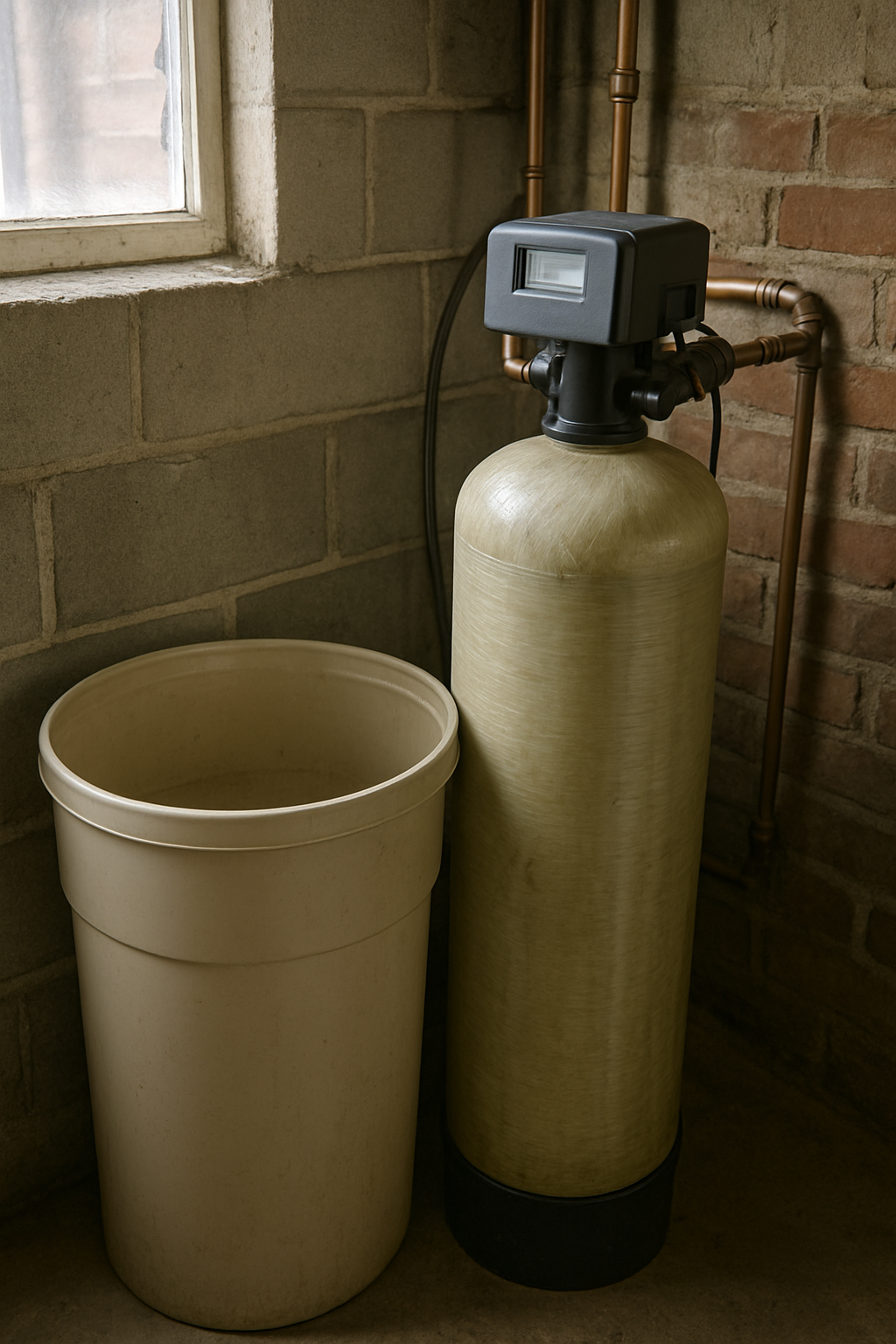
Once you’ve ruled out a bridge — the salt is loose and the water level looks normal — and the water’s still hard, the problem lives in one of two places: the control valve (the electronic head on top that runs the whole regeneration cycle) or the resin bed (the tank of beads that actually swaps calcium and magnesium out of your water).
Control valve symptoms: it doesn’t regenerate on schedule, an error code on the display, a motor that runs constantly or not at all, or a bypass valve stuck in position.
Resin bed symptoms: resin beads showing up in your water, hardness returning immediately after a full salt refill and regeneration, or noticeably reduced capacity even right after a fresh regen cycle — a sign the resin itself is fouled by iron or sediment and isn’t fully recovering anymore.
Why age changes the math
Water softeners aren’t built to run forever. The resin bed typically holds up 10 to 15 years under normal water conditions, and the control valve — the part that fails most often — has a similar working life. Under about 10 years old, a single failed component (a motor, an injector, a seal kit, a circuit board) is usually a straightforward, affordable repair, because parts are still stocked for the model. Past 12 to 15 years, you’re often looking at a valve failing right around the same time the resin is reaching the end of its life — and OEM parts for an older head get harder and more expensive to track down.
What repair costs vs. what replacement costs
A control valve repair — motor, injector, seal kit, or board — typically runs $150 to $400 including a service call, less if you’re comfortable doing it yourself with just the part. Resin replacement alone is usually $150 to $300 for a standard-size tank. A new water softener, properly sized for your household and installed, runs roughly $800 to $2,500 depending on capacity and features — metered, demand-initiated units cost more up front but use less salt and water over time than a basic timer model.
The decision, simply
Salt bridge if the water went hard suddenly and the tank’s had salt sitting untouched for a while — break it up, no cost involved. Repair if the unit is under about 10 years old and only one component (valve, motor, resin) is clearly at fault. Replace if it’s 12 to 15+ years old, more than one part is failing at once, or the resin is fouled beyond what cleaning or re-bedding fixes — at that point, paying for parts on an aging unit rarely beats a new one on cost per year.
DIY or not
Breaking up a salt bridge and running a manual regen cycle is fully DIY — no tools required. Swapping a control valve part like a motor or injector is a reasonable DIY project for a comfortable homeowner, with the water supply shut off and the owner’s manual in hand. Resin replacement and full-unit installation are also doable DIY jobs, though correctly sizing a new unit to your household’s water hardness and usage is where it’s easy to get wrong — worth a second opinion before you buy.
Not sure which one you’re looking at?
Tell me what the water’s doing, what the brine tank looks like inside, and how old the unit is. I’ll tell you whether this is a salt bridge, a valve repair, or time to replace — a written diagnostic with the specific read and honest next step, $19.99, back to you in minutes.