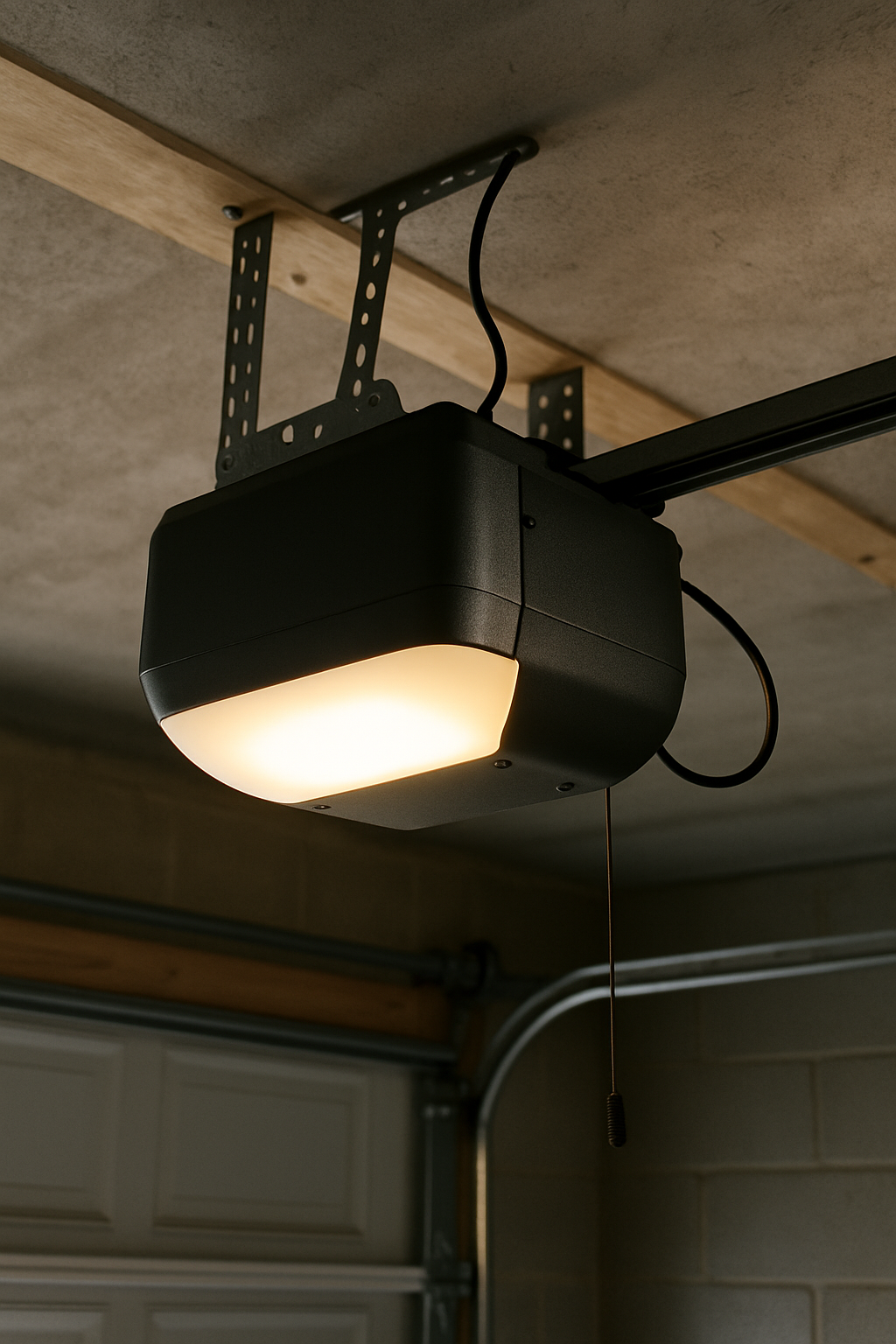
The garage door won’t close, or it starts closing and reverses back up for no obvious reason, and it feels like the whole opener has failed. Before you price a replacement, know this: the overwhelming majority of “the opener is broken” calls turn out to be one small, free thing. But there’s one specific behavior that genuinely is urgent and isn’t a wait-and-see situation.
Here’s how to sort it out.
Check this first: the safety sensors
Every garage door opener made since 1993 has two small photo-eye sensors mounted near the floor, one on each side of the door track, about 4-6 inches up. They send an invisible beam across the doorway; if anything breaks that beam while the door is closing, the door stops and reverses — that’s the federally required safety feature. These sensors get bumped out of alignment constantly — by a broom, a bike, a stored box, even just vibration over time. A door that won’t close, or reverses partway down with no obstruction present, is almost always a sensor alignment issue. Look for a small blinking or solid light on each sensor; if one is dark or flickering, gently realign it so both sensors face each other directly, and wipe any dust or cobwebs off the lenses. This fixes the majority of “broken opener” complaints in about two minutes, for free.
The motor runs but the door doesn’t move
If the opener motor clearly runs (you hear it) but the door doesn’t travel, especially on an older chain-drive opener, the culprit is often a small plastic drive gear inside the motor housing that’s worn or stripped. This is a known wear part on many opener models, and it’s a genuinely cheap DIY replacement (often under $20) if you’re comfortable opening the housing — a stripped gear doesn’t mean the whole opener is dead, just that one part.
The one that means stop and replace now
Here’s the actual safety issue: if you place something in the door’s path (a piece of wood, a trash can) while it’s closing and it does not stop and reverse, that’s not a minor inconvenience — that safety-reverse function is required by federal law precisely because a door that keeps closing on an obstruction is a real injury risk, especially around kids and pets. This isn’t something to live with or defer. If cleaning and realigning the sensors doesn’t restore reliable reverse behavior, replace the opener — don’t keep using one that fails this test.
When age alone is a reason to upgrade
Openers in the 15-20+ year range are worth replacing even absent a specific failure: older units often lack rolling-code security (making them more vulnerable to code-grabbing devices), parts get harder to source as models age, and newer openers add battery backup and smart connectivity that meaningfully improve convenience and security. If yours is in that age range and starting to act up at all, replacement is a reasonable call even before something fully breaks.
The decision, simply
Check the sensors first, always — it’s free and takes two minutes. Replace the drive gear if the motor runs but the door doesn’t move on an older chain-drive unit. Replace the whole opener immediately if it fails the obstruction-reverse test after sensor cleaning, or if it’s 15-20+ years old and acting up.
DIY or not
Sensor alignment and cleaning is about as DIY as it gets — no tools usually required. Swapping a drive gear is a reasonable DIY project if you’re comfortable working inside the opener housing with the power disconnected. Full opener replacement is also a common DIY install for a handy homeowner, though if you’re not confident with electrical connections or ladder work, it’s an inexpensive job to hire out.
Not sure which one you’re looking at?
Tell me what the door is actually doing (won’t close, reverses partway, motor runs but nothing moves) and how old the opener is. I’ll tell you whether this is a sensor fix, a part replacement, or time for a new opener — a written diagnostic with the specific read and honest next step, $19.99, back to you in minutes.