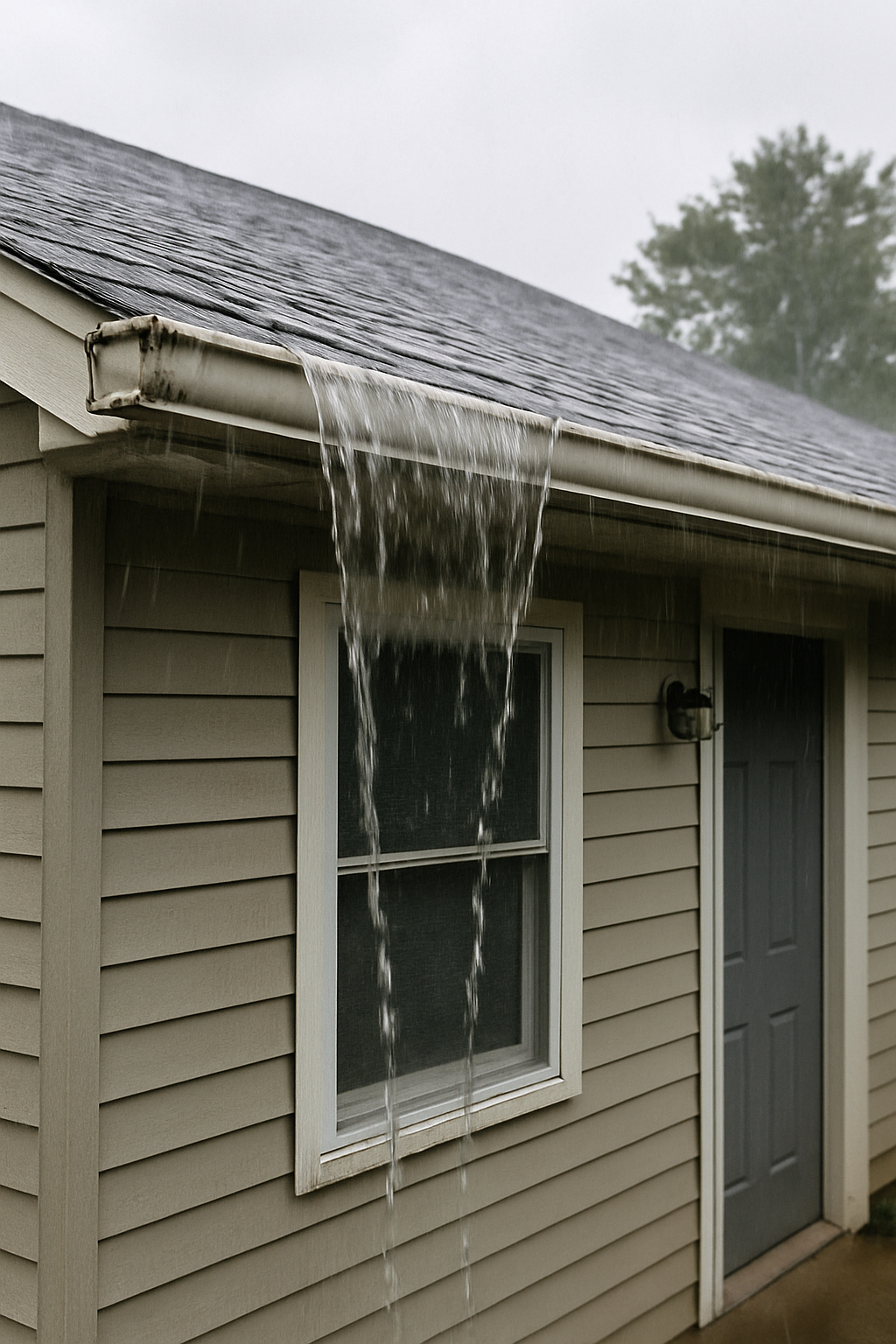
It rains hard, you look out the window, and there’s a sheet of water pouring over the front edge of the gutter like a little waterfall. The first thought is almost always the same: these gutters are shot, I need new ones. Most of the time you don’t. A gutter that overflows is usually a gutter that’s blocked, and the fix is a ladder and an afternoon — not a replacement crew. But a few things genuinely do mean replace, and one of them is doing quiet, expensive damage while you’re worrying about the wrong thing.
I’ve cleaned, re-hung, and replaced a lot of gutters on my own houses. The decision comes down to why it’s failing, and there are only a handful of real reasons.
First: an overflow is almost never the gutter’s fault
Water coming over the front lip means the gutter can’t move water fast enough, and there are three cheap reasons for that before you ever get to “worn out”:
- It’s clogged. Leaves, shingle grit, and a few seasons of sludge pack the trough and especially the downspout outlets. Water backs up and spills. Clean it and it’s fixed.
- The pitch is off. Gutters need a slight slope toward the downspouts — about a quarter inch of drop for every ten feet. A section that’s sagged flat holds water and overflows at the low spot. Often you can re-hang that run.
- The downspouts can’t keep up. Undersized or partly blocked downspouts, or too few of them, cause overflow even in a clean gutter. Adding or clearing a downspout is a small job.
None of those is a replacement. If your only symptom is overflow in heavy rain, start here — you’ll fix it eighty percent of the time.
Sign 1: it’s pulling away from the house
Stand back and look at the line of the gutter. If it’s sagging or leaning out from the fascia, figure out why before you condemn it. A gutter hung on old spike-and-ferrule fasteners that have worked loose can simply be re-secured with new hidden hangers — a repair. But if it’s pulling away because the fascia board behind it has gone soft, that’s a different and bigger problem, which brings us to the one that matters most.
Sign 2: rust-through, holes, and splitting seams
Old sectional steel gutters fail at the seams and the low spots. A pinhole of rust or one leaky joint is a patch. But when you’re seeing rust holes in several places, or seams that have split open up and down the run, you’re past patching — every repair just moves the leak. Sectional gutters have a joint every ten feet, and once the whole system starts letting go at the seams, replacing it with seamless aluminum is the honest call. Aluminum doesn’t rust, and a seamless run has no joints to fail except at the corners.
Sign 3: the fascia and soffit behind the gutter are rotting
This is the one that hides. When a gutter has leaked at the back edge for years — or overflowed behind itself because it was hung too high — water runs down the fascia board and into the soffit instead of away from the house. By the time you notice, the wood is dark, soft, and crumbling, and sometimes the roof sheathing at the edge is going too. Replacing the gutter alone doesn’t fix this. The rotted fascia has to come off and be rebuilt, and the new gutter gets hung on sound wood. If you push on the fascia and it gives, or you see peeling paint and dark streaks behind the gutter, budget for carpentry, not just gutters — and handle it soon, because rot only spreads.
The decision, simply
Repair when: the gutter overflows (clean it, re-pitch it, clear the downspouts), one hanger is loose, a single seam leaks, or there’s an isolated pinhole. These are ladder-and-caulk fixes measured in dollars and an afternoon.
Replace when: you’ve got rust-through or split seams in multiple places, the fascia behind it is rotting, or the whole system is old sectional steel that leaks at every joint. And if you’re already replacing the roof or rebuilding rotted fascia, replace the gutters at the same time — the access is never cheaper than when that edge is already open.
One sequencing note: gutters go on after new fascia and drip edge, not before. If a roofer or carpenter is touching that edge, that’s the moment to do the gutters too, so nobody’s paying to remove and re-hang them twice.
DIY or not
Cleaning gutters, clearing downspouts, and re-hanging a loose run are legitimately homeowner jobs if you’re steady on a ladder. Seamless aluminum replacement isn’t really DIY — the gutters are formed to length by a machine on site — but rebuilding a stretch of rotted fascia and hanging sectional gutter is doable if you’re comfortable working at the roofline. Either way, respect the ladder more than the gutter.
Not sure which one you’re looking at?
Send me a couple of photos — the gutter from the ground, a close-up of any rust or sagging, and the fascia board behind it if you can reach it. I’ll tell you whether you’re looking at a twenty-dollar cleaning, a re-hang, or a real replacement, and whether there’s fascia damage hiding behind it — a written diagnostic with the specific fix and honest cost, $19.99, back to you in minutes.